Data annotation services determine whether an AI model succeeds or fails in real-world conditions. In 2024, many organizations reported that poor-quality labeled data caused model failures, inaccurate predictions, and delayed product launches. For startups and scaling tech teams, the risk is clear: weak data annotation slows growth and wastes engineering effort.
If you are building an AI product or scaling one this question matters: can you afford to compromise on training data quality to save short-term costs?
This guide explains how AI data annotation works, what services startups actually need, how to evaluate providers, and why MoniSa’s AI data annotation service stands out as a long-term partner for startups and enterprises in 2026.
What Are Data Annotation Services?
Data annotation services involve labeling raw data so machine learning models can learn from it. Annotated data teaches models how to recognize patterns, make predictions, and perform tasks accurately.
At a basic level, data annotation answers one question:
“What does this data represent?”
Common annotation outputs include:
- Labeled text for NLP models.
- Tagged images for computer vision.
- Time-aligned transcripts for speech models.
- Classified or categorized datasets for recommendation engines.
A reliable data annotation company does more than label data. It ensures consistency, context, domain accuracy, and quality control at scale.
Why Do Startups Rely on Data Annotation Services?
Startups move fast and operate with limited resources. Most cannot afford large in-house annotation teams or complex QA systems.
Startups use data annotation services to:
- Reduce time to market.
- Avoid internal bottlenecks.
- Maintain consistent label quality.
- Scale datasets as models evolve.
What Types of Data Annotation Do AI Startups Need?
Text Annotation for NLP and LLMs
Text annotation supports chatbots, search, sentiment analysis, and large language models.
Typical tasks include:
- Named entity recognition (NER)
- Intent and intent-slot labeling
- Sentiment tagging
- Topic classification
Image Annotation for Computer Vision
Image annotation trains models to detect, classify, and recognize visual elements.
Common techniques include:
- Bounding boxes
- Polygon and semantic segmentation
- Landmark and keypoint labeling
- Object classification
Video Annotation for Temporal Understanding
Video annotation adds context across frames and time.
Use cases include:
- Object tracking
- Action recognition
- Event detection
- Autonomous driving datasets
Audio and Speech Annotation
Speech annotation enables voice assistants, transcription engines, and speech analytics.
Key tasks include:
- Speech-to-text transcription
- Speaker diarization
- Accent and dialect tagging
- Emotion and sentiment labeling
What Is AI Data Annotation and How Is It Different?
AI data annotation combines human expertise with AI-assisted workflows. Instead of labeling everything manually, annotators validate, correct, and refine machine-generated labels.
Benefits of AI-assisted annotation include:
- Faster turnaround times
- Lower costs at scale
- Improved consistency
- Continuous model feedback loops
The most effective data annotation companies use human-in-the-loop systems to balance speed and accuracy.
What Should Startups Look for in a Data Annotation Company?
1. Domain Expertise
Annotation quality depends on subject knowledge. Medical, legal, financial, and technical data require trained annotators. A strong provider matches datasets with domain-trained reviewers instead of generic labelers.
2. Quality Assurance Processes
Ask how providers ensure accuracy.
Look for:
- Multi-layer QA workflows
- Golden datasets for benchmarking
- Inter-annotator agreement checks
- Error tracking and feedback loops
High-quality data annotation services measure quality continuously, not just at delivery.
3. Scalability and Turnaround Time
Startups grow fast. Your annotation partner should scale volumes without sacrificing quality.
Scalability includes:
- Workforce expansion
- Tooling capacity
- Consistent QA at higher volumes
4. Multilingual and Cultural Accuracy
AI products often serve global users. Annotation must reflect language nuance, regional context, and cultural meaning. Native annotators and localized guidelines matter for NLP, sentiment, and speech models.
5. Security and Compliance
Training data often includes sensitive or proprietary information. A reliable data annotation company follows:
- Secure data access controls
- NDAs and confidentiality agreements
- GDPR and ISO-aligned processes
- Security failures can damage both products and reputations
Top Data Annotation Companies in India (2026)
India remains a global hub for data annotation services due to its skilled workforce, multilingual talent, and cost efficiency.
Leading Providers Overview
| Rank | Company | Key Strength |
|---|---|---|
| 1 | MoniSa Enterprise | Multilingual, ISO-certified, startup-friendly |
| 2 | iMerit | Computer vision and healthcare expertise |
| 3 | Playment (TELUS) | 3D and autonomous data |
| 4 | Sama | Human-in-the-loop enterprise workflows |
| 5 | CloudFactory | Managed annotation operations |
| 6 | SuperAnnotate | Platform-based annotation |
| 7 | Labelbox | Model-assisted labeling |
| 8 | Cogito Tech | Cost-focused annotation |
| 9 | Appen | Large-scale global datasets |
| 10 | Lionbridge / TELUS | Linguistic QA and localization |
Why MoniSa’s AI Data Annotation Service Leads in 2026
Annotation Across All Modalities
- Text, image, audio, video, LiDAR, and multimodal datasets.
- Structured workflows for NLP, computer vision, and speech AI.
- LLM and NLP Readiness.
Prompt annotation
- Intent and entity labeling.
- Bias detection and evaluation datasets.
- Human-in-the-loop review pipelines.
Multilingual Strength
- 300+ languages supported
- Rare and regional dialect expertise
- Native-speaker annotators
Quality-First Delivery
- ISO 9001 and ISO 17100-aligned QA
- Multi-step review workflows
- Continuous accuracy tracking
Startup-Friendly Engagement
- Pilot projects before scale
- Phased delivery models
- Transparent, project-based pricing
Security and Compliance
- ISO 27001-aligned security practices
- GDPR-ready workflows
- NDA-backed infrastructure
Real-World Use Cases Delivered by MoniSa
- Multilingual NLP datasets for conversational AI
- Speech and video annotation across 50+ languages
- LLM training datasets for global AI platforms
- Domain-specific annotation for healthcare and BFSI
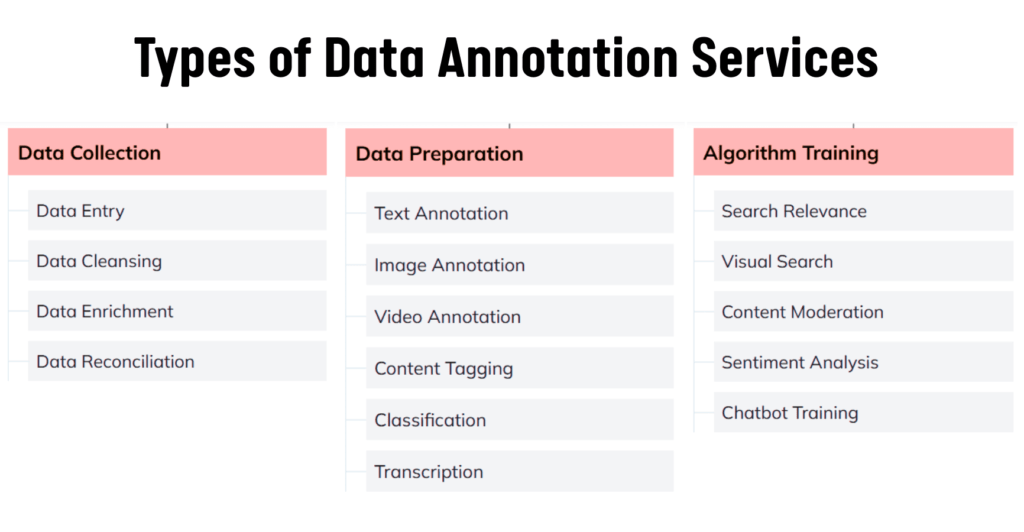
What Do Data Annotation Services Include?
1) Data Preparation
- Data collection and ingestion
- Data cleaning and normalization
- Metadata enrichment
2) Core Annotation Tasks
- Text annotation
- Image and video labeling
- Audio transcription
- Classification and tagging
3) Model Training Support
- Search relevance labeling
- Content moderation datasets
- Sentiment analysis annotation
- Chatbot and intent training
A strong provider integrates these services into a single workflow instead of fragmented tasks.
Which Annotation Tools Do Startups Use?
Popular tools include:
- Labelbox
- SuperAnnotate
- CVAT
- Custom internal tools
However, tools alone do not guarantee quality. The real value comes from trained annotators, strong QA, and workflow design.
This is why many startups combine tools with professional data annotation services instead of relying on software alone.
Common Challenges in AI Data Annotation (and How to Solve Them)
| Challenge | Problem | MoniSa Solution |
|---|---|---|
| Inconsistent Quality | Different annotators interpret labels differently. | Clear guidelines, gold datasets, and reviewer audits |
| Rising Costs | Video and audio annotation becomes expensive at scale. | Model-assisted labeling and phased annotation strategies |
| Lack of Domain Knowledge | Generic annotators mislabel complex data. | Domain-trained reviewers and expert escalation layers |
| Multilingual Errors | Literal translations miss context. | Native speakers and culturally localized guidelines |
| Data Security Risks | IP exposure during outsourcing. | Secure access controls, NDAs, and compliance audits |
When Should Startups Outsource Data Annotation?
Outsource when:
- Internal teams lack annotation expertise
- Dataset size grows rapidly
- QA requirements exceed internal capacity
- Multilingual or domain-specific data is required
Outsourcing allows startups to scale safely without slowing innovation.
How Much Do Data Annotation Services Cost?
- Data modality
- Volume
- Language coverage
- Turnaround time
- QA depth
Summary
Data annotation services directly impact AI accuracy, speed, and scalability. For startups and tech teams, choosing the right AI Data Training Company prevents costly model failures. MoniSa’s AI data annotation service combines multilingual expertise, strong QA, and flexible engagement models making it a reliable partner for AI development in 2026.