Why Do Enterprises Still Lose Millions After “Finishing” Data Annotation?
If data annotation were a solved problem, enterprise AI teams would not be allocating 30–40% of total AI project cost to post-deployment fixes. Yet that is exactly what happens. According to multiple industry audits across healthcare, autonomous systems, and enterprise NLP, model failures rarely trace back to algorithm choice. They trace back to inconsistent labeling, unclear annotation logic, or tooling that failed to scale beyond pilot datasets.
Annotation today is no longer a tactical task handled by interns or outsourced vendors in isolation. It sits at the center of model reliability, regulatory defensibility, and time-to-market. Tools that cannot integrate cleanly with ML pipelines, version datasets, or support human-in-the-loop review introduce silent risk. This article breaks down the top AI data annotation tools with API integration, how enterprises should evaluate them, and where each tool actually performs well—or fails—under real production pressure.
How to Choose the Right Open-Source Annotation Tool
Open-source annotation tools attract teams for obvious reasons: flexibility, cost control, and deployment ownership. But many organizations underestimate the operational burden that comes with those benefits. Choosing an open-source tool is not a technical decision alone; it is an infrastructure decision that affects engineering velocity and annotation quality months later.
Scalability beyond proof-of-concept
Most open-source annotation tools perform adequately when teams label a few thousand images or documents. Problems surface when datasets reach millions of assets, concurrent annotators increase, or video resolution grows. Browser-rendered tools often slow dramatically under load, forcing teams to throttle throughput or segment datasets artificially. Enterprises must evaluate whether the tool can sustain production-scale workloads without constant engineering intervention.
API-first integration capability
Annotation does not exist in isolation. Data flows from ingestion pipelines into annotation queues, then into training environments, evaluation dashboards, and retraining loops. Tools that expose robust APIs allow teams to automate dataset creation, task distribution, annotation export, and quality checks. Without this, annotation becomes a manual choke point that undermines CI/CD practices in ML.
Dataset versioning and auditability
Regulated industries increasingly require traceability between datasets and deployed models. Teams must demonstrate which labeled dataset trained which model version, who annotated it, and what changes occurred over time. Many open-source tools lack native dataset versioning, forcing teams to rely on external systems or brittle naming conventions.
Support for diverse data modalities
Real-world AI systems rarely operate on a single data type. Autonomous systems combine video, LiDAR, and sensor data. Enterprise NLP combines documents, chat logs, and audio transcripts. Tool selection must reflect this complexity. A tool optimized for bounding boxes may fail entirely when teams introduce audio or text classification.
Security, deployment, and compliance control
Self-hosting offers control but shifts responsibility. Teams must manage authentication, access controls, encryption, and audit logs. Without mature DevOps practices, open-source tools can introduce compliance risks rather than reduce them.
Community maturity and update cadence
Active development matters. Annotation requirements evolve quickly as models grow more capable. A stagnant tool, even if popular historically, can fall behind in months.
Got it.
Below is a deep, tool-by-tool expansion ONLY for:
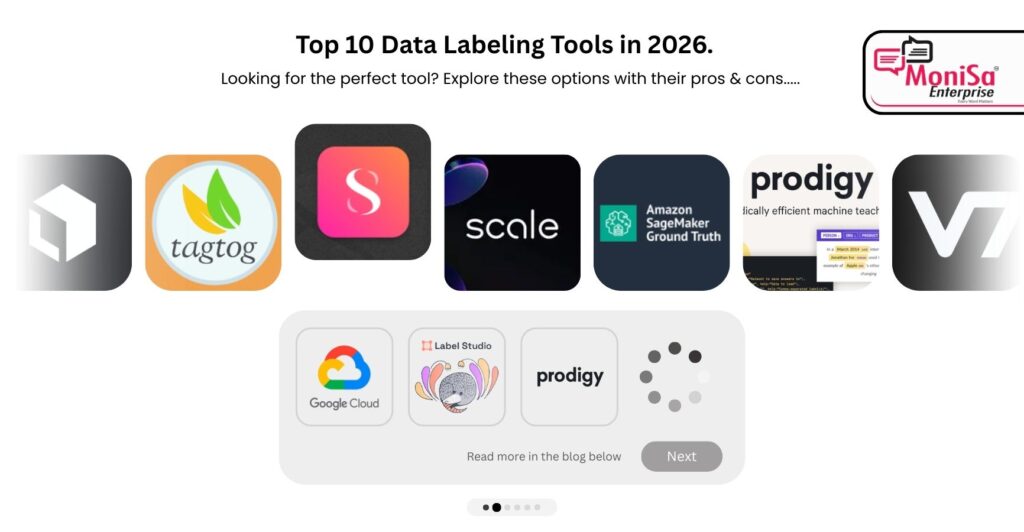
Top 10 Data Labeling Tools in 2026
Labelbox
Labelbox is not just an annotation tool; it functions as a data operations layer for teams that treat training data as a first-class ML asset. Enterprises usually adopt Labelbox when annotation must stay tightly coupled with model iteration, error analysis, and governance.
Labelbox’s real strength shows up once teams move beyond static datasets. The platform allows ML engineers to push model predictions back into annotation queues, prioritize uncertain samples, and continuously refine datasets using active learning loops. This makes it especially attractive for organizations running continuous training pipelines rather than one-off model builds.
From an operational standpoint, Labelbox supports large distributed teams. Annotation instructions, review logic, and escalation paths live inside the platform instead of scattered across documents and Slack threads. That structure matters when multiple teams label data across geographies.
Core features
- Model-assisted labeling using pre-trained or in-house models
- Dataset versioning tied to experiments and deployments
- Multi-layer review workflows with confidence scoring
- REST APIs for dataset ingestion and export
Labelbox pricing typically follows a usage-based enterprise contract, often negotiated annually. Costs increase with video data, model-assisted features, and advanced governance modules.
Pros
- Strong alignment with MLOps workflows
- Excellent traceability for audits and regulated industries
Cons
- Pricing escalates quickly at scale
- Requires process maturity to extract full value
SuperAnnotate
SuperAnnotate is built for environments where annotation errors create downstream risk, not just model noise. Robotics, medical imaging, defense, and industrial vision teams use it when pixel-level precision directly affects safety or compliance.
Unlike platforms optimized for speed, SuperAnnotate prioritizes annotation discipline. It enforces structured review layers, inter-annotator agreement checks, and fine-grained error analysis. Teams often deploy it when annotation guidelines grow complex and informal QA no longer works.
The platform performs exceptionally well with high-resolution images and long video sequences. Annotation tools allow granular control over polygons, masks, and temporal segments without relying heavily on automation that might introduce subtle errors.
Core features
- High-precision image and video annotation tools
- Multi-pass QA and consensus scoring
- Python SDK for pipeline automation
Pricing reflects annotation complexity and QA depth, not just data volume. Enterprises typically pay more per asset but reduce costly rework later.
Pros
- Exceptional annotation accuracy
- Strong QA enforcement
Cons
- Limited NLP and audio support
- Slower throughput for low-risk tasks
Scale AI
Scale AI operates differently from most tools on this list. It combines annotation software with a managed human workforce, effectively outsourcing annotation operations while maintaining API-driven integration.
Enterprises choose Scale when internal annotation teams cannot scale fast enough or when rapid dataset expansion outweighs long-term cost optimization. Autonomous vehicle companies, for example, use Scale to label massive sensor datasets under tight timelines.
From a buyer perspective, Scale shifts annotation from a tooling decision to a service contract. You gain speed and delivery guarantees but trade off control and transparency.
Core features
- Large on-demand global annotation workforce
- Automated task routing and QA layers
- APIs for submitting tasks and retrieving labeled data
Pricing varies significantly based on task type, SLA requirements, and volume. Long-term contracts often cost more than internal tooling but reduce operational overhead.
Pros
- Extremely fast turnaround at scale
- Minimal internal management burden
Cons
- Limited visibility into annotator profiles
- Higher long-term cost
Amazon SageMaker Ground Truth
Ground Truth exists primarily to serve teams already embedded in the AWS ecosystem. It integrates directly with S3, SageMaker training jobs, and AWS IAM, reducing friction for cloud-native ML pipelines.
The service supports three modes: human labeling, automated labeling, and hybrid workflows where models label data and humans review uncertain samples. This works well for incremental dataset growth, especially when cost control matters.
However, Ground Truth places less emphasis on annotation UX. Many teams treat it as infrastructure rather than a collaborative annotation environment.
Core features
- Native AWS integration
- Automated labeling using active learning
- Managed and private workforce options
Pricing follows AWS’s consumption model, which can be cost-effective for intermittent use but harder to forecast at scale.
Pros
- Seamless AWS compatibility
- Scales reliably within cloud pipelines
Cons
- UI not optimized for annotators
- AWS lock-in
Google Cloud Data Labeling
Google Cloud’s data labeling service targets teams building vision and NLP models directly on GCP. It integrates smoothly with Vertex AI and Big Query, making dataset handoffs straightforward.
The tool performs well for text classification and entity extraction, benefiting from Google’s language tooling. However, it offers limited flexibility for custom workflows compared to standalone platforms.
Core features
- GCP pipeline integration
- Pre-trained model assistance
Pros
- Strong NLP performance
- Familiar environment for GCP users
Cons
- Limited customization
- Less suitable for complex video tasks
CVAT
CVAT remains one of the most widely deployed open-source annotation tools for computer vision. Enterprises adopt it when they require full control and can support internal maintenance.
CVAT handles bounding boxes, polygons, and video tracking effectively, but it relies on external systems for QA, versioning, and workflow orchestration. Teams often pair it with internal tooling or third-party QA processes.
Core features
- Image and video annotation
- Self-hosted deployment
Pros
- No licensing cost
- Highly customizable
Cons
- Limited native QA
- Requires engineering investment
Label Studio
Label Studio stands out among open-source tools for its multimodal flexibility. Teams use it to annotate text, audio, images, and hybrid datasets without switching platforms.
Its template system allows custom labeling schemas, which suits research teams and experimental workflows. At scale, however, performance tuning becomes essential.
Core features
- Custom labeling templates
- Multimodal support
Pros
- Flexible and extensible
- Strong NLP and audio support
Cons
- Scaling requires optimization
- Limited built-in governance
V7
V7 targets computer vision teams that want automation-first workflows. It emphasizes dataset visualization, annotation acceleration, and integration with training pipelines.
The platform suits organizations iterating rapidly on vision models where annotation speed directly affects deployment cycles.
Core features
- Automated labeling suggestions
- Visual dataset analytics
Pros
- Fast iteration cycles
- Clean, modern interface
Cons
- Narrow focus on vision
- Limited NLP support
Prodigy
Prodigy appeals to NLP engineers who prefer scripting over UI-heavy tools. It integrates directly into Python workflows and supports rapid annotation loops driven by model uncertainty.
Teams use Prodigy for high-quality, low-volume datasets, especially in early model development.
Core features
- Python-native workflows
- Active learning loops
Pros
- Extremely fast for developers
- Lightweight and flexible
Cons
- Minimal collaboration features
- Not suited for large teams
Tagtog
Tagtog specializes in document-centric and biomedical text annotation. Enterprises in healthcare and life sciences adopt it for its focus on traceability and compliance.
The platform supports structured review workflows and long-form document annotation, making it suitable for regulated NLP tasks.
Core features
- Document-level annotation
- Audit-ready workflows
Pros
- Strong compliance orientation
- Well-suited for biomedical NLP
Cons
- Limited vision support
- Smaller ecosystem
Enterprise Comparison Table
AI Data Annotation Tools with API Integration
| Tool Name | Supported Data Types | Annotation Capabilities | API & Pipeline Integration | Collaboration & QA | Scalability & Enterprise Readiness | Typical Enterprise Fit |
|---|---|---|---|---|---|---|
| Labelbox | Image, video, text, geospatial | Bounding boxes, polygons, segmentation, NER, classification, video frame annotation | Full REST APIs, SDKs, ML pipeline hooks, dataset versioning | Role-based access, consensus review, audit logs | High – used by Fortune 500 ML teams | Computer vision, autonomous systems, enterprise AI labs |
| Scale AI | Image, video, text, LiDAR | High-precision CV labeling, multimodal annotation, instruction tuning | Deep API-first workflows, tight MLOps integration | Managed QA layers, reviewer arbitration | Very high – designed for massive datasets | Autonomous driving, defense, foundation models |
| SuperAnnotate | Image, video, text | Pixel-level segmentation, video tracking, NLP tagging | APIs for dataset sync, export to major ML frameworks | Team workflows, reviewer feedback loops | High – strong for large CV teams | Medical imaging, retail vision, industrial AI |
| Appen | Text, speech, image, video | Linguistic annotation, speech labeling, content moderation | APIs combined with managed services | Human QA at scale, multi-layer validation | High, but service-heavy | NLP, speech models, multilingual AI |
| Toloka | Text, image, video, audio | Classification, relevance grading, speech transcription | APIs for task orchestration, workforce control | Statistical quality control, gold-task validation | Medium–High depending on task design | Search relevance, NLP evaluation, data validation |
| Label Studio | Text, image, audio, video, time-series | Highly customizable labeling templates | Open APIs, self-hosted integration flexibility | Manual QA workflows, plugin-based extensions | Medium – depends on infra maturity | Startups, research teams, custom workflows |
| V7 Labs | Image, video | Automated + human CV annotation, active learning | APIs for dataset ingestion and model feedback | Annotation review queues, model-assisted QA | High for vision-centric teams | Manufacturing, robotics, medical imaging |
| Hive | Image, video, text | Content moderation, CV/NLP labeling | API-first moderation and labeling endpoints | Internal QA teams, SLA-based accuracy | High for real-time workloads | Social platforms, UGC moderation, ad tech |
| Snorkel AI | Text, image | Weak supervision, labeling functions (not manual-first) | APIs integrate directly into model training | QA via statistical validation, not human review | High for ML-mature orgs | Enterprises reducing manual labeling cost |
| iMerit | Image, video, text, speech | High-accuracy managed annotation | APIs combined with human delivery pipelines | Multi-stage human QA, domain experts | High, service-led | Healthcare AI, regulated industries |
How MoniSa Integrates AI Annotation Tools With Human Precision
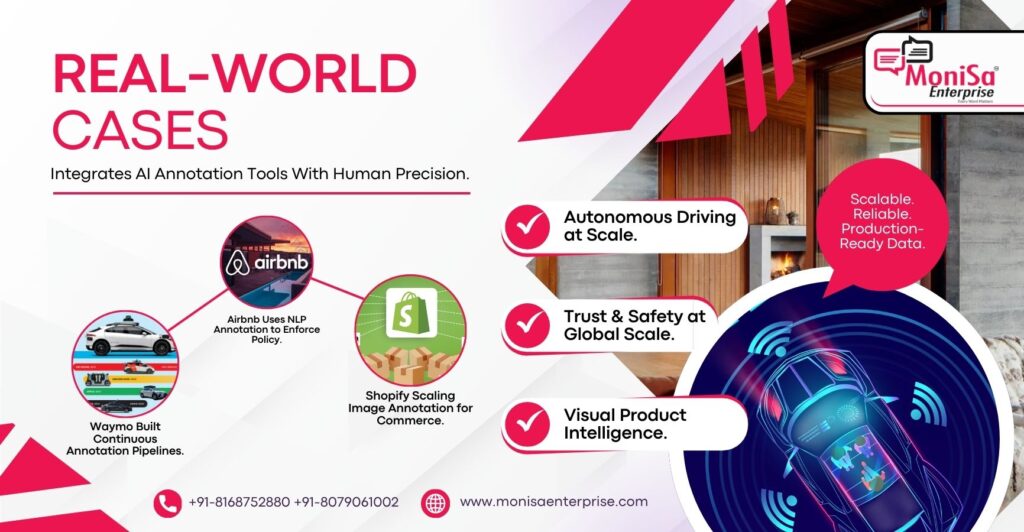
At MoniSa Enterprise, annotation tools function as accelerators, not decision-makers. The organization integrates selected platforms into a structured human-in-the-loop pipeline where AI assists throughput, and trained linguists and domain experts handle ambiguity.
This approach matters most in low-resource languages, regulated industries, and culturally sensitive datasets. Automated labeling struggles with contextual meaning, regional variation, and domain-specific terminology. Human review layers correct these gaps systematically, not reactively.
MoniSa’s workflow combines API-driven annotation tools with custom QA frameworks, enabling consistent quality across 320+ languages without sacrificing scalability.
Real-World Use Cases
1. Autonomous Driving at Scale
Waymo Built Continuous Annotation Pipelines
Waymo’s autonomous driving program did not stall because of model architecture. It stalled early on because training data could not keep up with edge cases. Every mile driven produced new visual scenarios—unprotected left turns, construction zones, unusual pedestrian behavior—that existing datasets failed to represent.
Waymo publicly documented that it relies on human-in-the-loop data labeling combined with internal and third-party annotation tooling to continuously retrain perception models. Video streams from multiple cameras, LiDAR point clouds, and sensor fusion outputs require synchronized annotation across time, not static labeling.
Here is where annotation tooling with API integration becomes non-negotiable.
Waymo uses automated perception models to pre-label objects such as vehicles, cyclists, and pedestrians. These predictions then flow into annotation systems where trained labelers correct bounding boxes, adjust temporal consistency across frames, and flag ambiguous cases. The corrected labels do not sit in isolation. Waymo’s infrastructure feeds them directly back into training pipelines.
What made the difference operationally was annotation feedback loops:
- Model errors detected in simulation or real-world testing were automatically pushed back into annotation queues.
- Updated annotation guidelines propagated across teams through tooling, not PDFs.
- Dataset versions were tightly coupled with model builds, allowing engineers to trace performance regressions to specific labeling changes.
This approach required tooling that supported high-resolution video annotation, temporal tracking, and API-based dataset versioning—capabilities associated with platforms like Labelbox, SuperAnnotate, and internally customized CVAT deployments.
The result: faster iteration on rare scenarios and measurable improvements in disengagement rates. Annotation was no longer a cost center; it became a safety-critical system component.
2. Trust & Safety at Global Scale
How Airbnb Uses NLP Annotation to Enforce Policy
Airbnb operates in more than 220 countries and regions, handling millions of user-generated messages, reviews, and listings. Moderating this content manually is impossible, yet automated moderation alone creates unacceptable false positives and negatives.
Airbnb has publicly discussed its Trust & Safety ML stack, which relies on large-scale text annotation to train and refine models that detect fraud, discrimination, off-platform payment attempts, and policy violations.
The real challenge was not building models. It was keeping annotation aligned with policy changes.
Airbnb policies evolve constantly due to regulatory pressure, regional laws, and real incidents. Every policy update requires:
- New annotation schemas
- Re-labeling of historical data
- Rapid turnaround without breaking production systems
Airbnb uses internal and external annotation platforms with API-driven workflows to handle this. When policy definitions change, annotation templates update programmatically. Annotators re-label only affected data segments, not entire corpora. Models retrain incrementally, not from scratch.
Tools in this workflow resemble Prodigy and Label Studio–style systems: scriptable, NLP-first, tightly integrated with Python-based ML pipelines. Annotation outputs feed directly into training and evaluation jobs, closing the loop between policy intent and model behavior.
The business impact is concrete:
- Reduced false positives in moderation
- Faster policy rollout across regions
- Lower manual review load for Trust & Safety teams
This is annotation as policy enforcement infrastructure, not dataset preparation.
3. Visual Product Intelligence
Shopify Scaling Image Annotation for Commerce
Shopify hosts millions of merchants, each uploading product images with inconsistent structure, metadata, and quality. To power visual search, automated tagging, and recommendation systems, Shopify needed accurately labeled product imagery across categories that change constantly.
Shopify engineering teams have publicly shared how they combine machine-generated labels with human annotation to maintain catalog quality. Automated models classify products and detect attributes, but edge cases—fashion variants, ambiguous product types, regional differences—require human correction.
Annotation tools with API integration allow Shopify to:
- Automatically ingest new product images into labeling queues
- Route uncertain predictions to human reviewers
- Export corrected labels back into search and recommendation pipelines
What matters here is incremental annotation, not bulk labeling. Products change daily. Seasonal catalogs shift. Merchants upload new images continuously. Annotation tooling that supports partial dataset updates and programmatic task creation enables Shopify to keep models current without massive re-labeling costs.
Platforms similar to Labelbox and Scale AI are well-suited for this workload: high-volume image annotation, integration with production systems, and quality checks aligned with business KPIs like search relevance and conversion rate.
The outcome is measurable. Better image annotation improves product discoverability, which directly impacts merchant revenue and platform GMV.
Feature Comparison Across Platforms
- Supported data types
True multimodal support remains limited to a few platforms. Most tools specialize narrowly and require integration stacks to cover gaps. - Annotation task depth
Advanced tasks like temporal segmentation and 3D cuboids separate enterprise tools from entry-level platforms. - Ease of use
Developer-centric tools favor scripting. Enterprise platforms balance usability with governance. - Collaboration and QA
Production annotation requires reviewer layers, conflict resolution, and escalation logic. - Model integration readiness
Export formats, dataset lineage, and retraining compatibility determine long-term viability.
Conclusion
By 2026, AI data annotation has moved far beyond tool selection. Enterprises that succeed treat annotation as an operational system—where APIs, workflows, QA logic, and human expertise work together. The comparison shows that no single platform fits every use case. Some excel at automation and speed, others at domain accuracy or compliance. The real differentiator lies in how well these tools integrate into production pipelines and how teams control quality when models encounter edge cases.
This is where execution matters more than software. At MoniSa, annotation strategies combine API-driven platforms with trained human reviewers, risk-based QA, and domain-specific validation. The focus stays on reducing rework, improving model stability, and protecting downstream ROI. If your AI models underperform after deployment, the root cause often sits in annotation design, not in the model itself.
Evaluating annotation platforms or struggling with production-quality data? Connect with MoniSa to build annotation workflows that support real-world AI performance, not just benchmarks.