A Complete Guide to Translation Services in India for Global Businesses
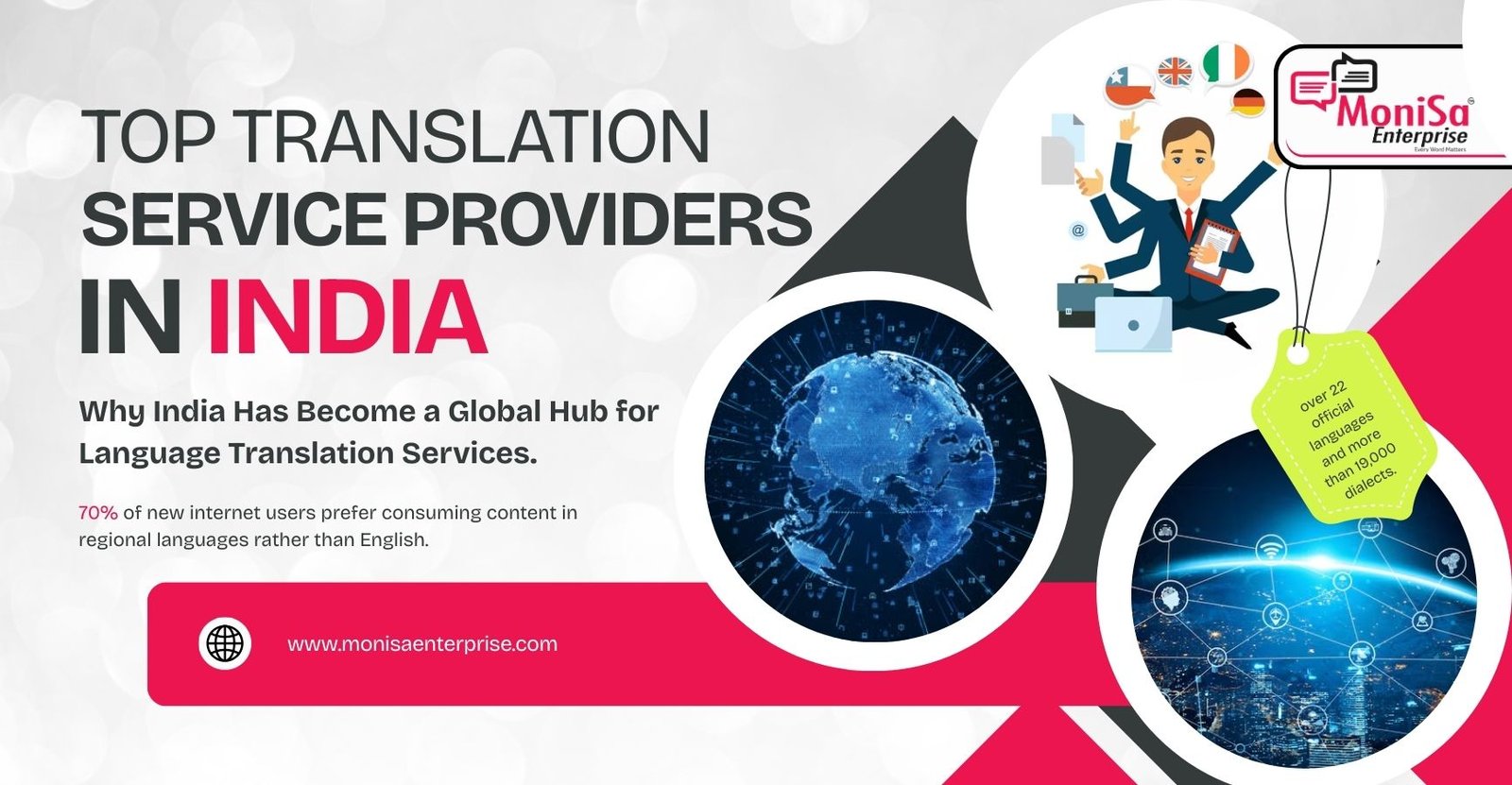
Did you know that India is home to over 22 official languages and more than 19,000 dialects, according to the Census of India? At the same time, the global language services market is projected to exceed $96 billion by 2028, according to industry reports from CSA Research and Nimdzi.
This combination of linguistic diversity and a rapidly expanding digital economy has positioned India as one of the most strategic hubs for language translation services. Businesses entering Indian markets require localization across multiple regional languages, while global companies increasingly outsource multilingual operations to Indian providers because of cost efficiency, linguistic talent, and scalable service infrastructure.
Today, translation services in India are no longer limited to document translation. Providers deliver a wide range of specialized services including website localization, software localization, legal and medical translation, multimedia subtitling, AI data annotation, multilingual SEO, and interpretation services. With enterprises expanding across borders faster than ever, the demand for certified translation services in India and reliable professional translation companies has grown significantly.
This guide explores the top translation service providers in India, key evaluation factors for choosing the right vendor, and the industries driving demand for multilingual communication.
Why India Has Become a Global Hub for Language Translation Services
India’s translation industry has grown rapidly in the past decade due to several structural advantages. Global companies are increasingly choosing Indian language service providers because the ecosystem offers scalability, cost efficiency, and access to highly skilled linguistic professionals.
Several factors contribute to this growth.
1. Massive Linguistic Diversity
India’s linguistic environment naturally supports translation expertise. Professional translators regularly work across languages such as Hindi, Bengali, Tamil, Telugu, Marathi, Kannada, Gujarati, and Malayalam alongside global languages like English, Spanish, French, and German.
This multilingual environment allows translation companies to build strong localization teams.
2. Cost Efficiency Compared to Western Markets
Professional translation services in India typically cost 30–60% less than services offered in North America or Western Europe. Lower operational costs enable Indian translation companies to provide competitive pricing while maintaining quality standards.
3. Strong IT and Localization Infrastructure
India’s strong technology sector has also contributed to the development of advanced translation workflows, including:
- Translation Management Systems (TMS)
- AI-assisted translation tools
- Multilingual content automation
- Global localization platforms
These technologies allow Indian companies to handle large-scale multilingual projects efficiently.
What Services Do Professional Translation Companies in India Offer?
Modern translation providers deliver far more than simple text conversion. Companies now offer comprehensive language solutions that support global expansion.
| Service Category | Description | Industries Using It |
|---|---|---|
| Document Translation | Business, legal, financial, and academic documents | Legal, corporate |
| Website Localization | Multilingual websites and digital platforms | E-commerce, SaaS |
| Software Localization | Adapting software interfaces for regional markets | Technology |
| Subtitling & Media Localization | Video translation and captioning | Media, entertainment |
| Interpretation Services | Real-time multilingual communication | Conferences, healthcare |
| Multilingual SEO | Optimizing content for international search | Digital marketing |
| Certified Translation Services in India | Legally recognized translation documents | Immigration, legal |
These services help organizations communicate accurately across linguistic and cultural boundaries.
Top Translation Service Providers in India
India hosts hundreds of translation vendors, but a few companies have developed strong reputations due to their industry expertise, service range, and global client base.
| Company | Key Services | Headquarters |
|---|---|---|
| Lionbridge India | Localization, translation, AI data services | Mumbai |
| TransPerfect India | Enterprise localization and translation | Bangalore |
| RWS India | Language technology and translation | Mumbai |
| MoniSa Enterprise | Multilingual translation across 300+ languages | India |
| Verbolabs | Media localization and subtitling | Jaipur |
| Somya Translators | Multilingual translation services | Delhi |
| Shakti Enterprise | Certified translation services | Ahmedabad |
| Linguainfo Services | Business and technical translation | Pune |
| LanguageNoBar | Digital translation and localization | Mumbai |
| Tridindia IT Translation | Document and technical translation | Noida |
These companies differ in specialization. Some focus on enterprise localization, while others emphasize certified document translation or multimedia localization. Businesses should choose providers based on project requirements rather than company size alone.
How to Choose the Right Translation Services in India
India currently has over 850 million internet users, and multiple industry reports indicate that more than 70% of new internet users prefer consuming content in regional languages rather than English. This shift has fundamentally changed how organizations approach communication, forcing companies to move beyond occasional translation projects toward structured multilingual strategies. As a result, selecting a professional translation company requires assessing operational maturity, linguistic depth, and long-term scalability rather than simply comparing pricing or turnaround times.
Below are the most important factors businesses should evaluate before choosing a translation partner.
1. Language Coverage vs. Linguistic Expertise
Many vendors promote extensive language lists, sometimes claiming support for hundreds of languages. However, language availability alone does not indicate translation quality. India’s linguistic complexity makes this distinction especially important because regional variation often influences meaning, tone, and audience reception.
For example, Hindi used in North Indian corporate communication differs noticeably from conversational Hindi used in consumer-facing campaigns. Similarly, Tamil, Bengali, and Marathi audiences respond differently to tone, idioms, and cultural references. A reliable provider offering language translation services should demonstrate access to native linguists with regional specialization rather than relying solely on generalized translation resources.
2. Industry-Specific Expertise Matters More Than Volume
Translation accuracy depends heavily on subject-matter knowledge. A provider experienced in marketing localization may not be suitable for legal contracts, financial disclosures, or medical documentation where terminology precision carries regulatory implications.
India has seen strong growth in sectors such as healthcare outsourcing, fintech, SaaS, and e-learning, all of which require specialized translation workflows. According to industry observations, errors in regulated content frequently arise not from language mistakes but from incorrect contextual interpretation of technical terminology.
When evaluating certified translation services in India, businesses should verify:
- Experience within the relevant industry vertical
- Use of approved terminology glossaries
- Quality review by subject specialists
- Compliance familiarity for regulated documents
Companies handling immigration paperwork, legal filings, or government submissions should also confirm whether translations meet certification and notarization requirements where applicable.
3. Technology Infrastructure and Workflow Integration
Modern translation workflows increasingly rely on technology platforms rather than manual file exchanges. Translation Management Systems (TMS), terminology databases, and AI-assisted tools now play a central role in maintaining consistency and reducing turnaround times.
Research from localization industry analysts shows that organizations using centralized translation workflows can reduce localization timelines by up to 30–40% compared to fragmented processes. Technology integration also improves version control and minimizes repetitive translation costs through translation memory reuse.
Key questions to ask a professional translation company include:
- Do they use translation memory and terminology management tools?
- Can workflows integrate with CMS, product platforms, or design tools?
- How is quality tracked across revisions?
- Are AI tools supervised by human linguists?
Technology should support human expertise rather than replace it, particularly for brand-sensitive or regulated content.
4. Quality Assurance Processes and Review Layers
Quality assurance remains one of the most overlooked evaluation factors when selecting translation services. Many vendors describe quality broadly without explaining how reviews are conducted or measured.
Professional providers typically follow multi-step workflows involving translation, editing, proofreading, and linguistic validation. Some organizations also implement automated QA checks to identify inconsistencies, formatting issues, or terminology deviations before final delivery.
A mature QA process often includes:
- Dual linguist review models
- Style guides aligned with brand voice
- Terminology validation tools
- Client feedback loops for continuous improvement
Businesses should request sample workflows rather than relying on general quality claims.
5. Scalability and Project Management Capability
As companies grow, translation needs often expand rapidly—from occasional document translation to ongoing multilingual content pipelines. Vendors that perform well for small assignments may struggle with high-volume or multi-market projects.
India’s translation market includes freelancers, boutique agencies, and enterprise-scale providers, each suited to different project sizes. Organizations planning long-term multilingual expansion should evaluate whether the provider can handle fluctuating workloads, multiple stakeholders, and simultaneous language releases.
6. Pricing Transparency and Long-Term Cost Efficiency
While cost remains an important consideration, the lowest pricing model often leads to higher long-term expenses due to rework, inconsistent terminology, or delayed launches. Businesses should analyze pricing structures in relation to workflow maturity and quality controls.
Translation providers offering structured processes and reusable linguistic assets frequently deliver better ROI over time because translation memory reduces repetition costs and accelerates future projects.
7. Cultural Adaptation Capabilities
Translation alone does not guarantee audience acceptance. Cultural adaptation—often referred to as localization—plays a critical role in how messaging is perceived across India’s diverse cultural landscape.
Campaigns that perform well in metropolitan markets may require tonal adjustments for regional audiences where cultural values, humor, and communication norms differ. Providers experienced in localization can guide messaging adjustments while maintaining brand intent.
As regional-language digital consumption continues to grow, culturally informed translation increasingly influences customer engagement and brand credibility.
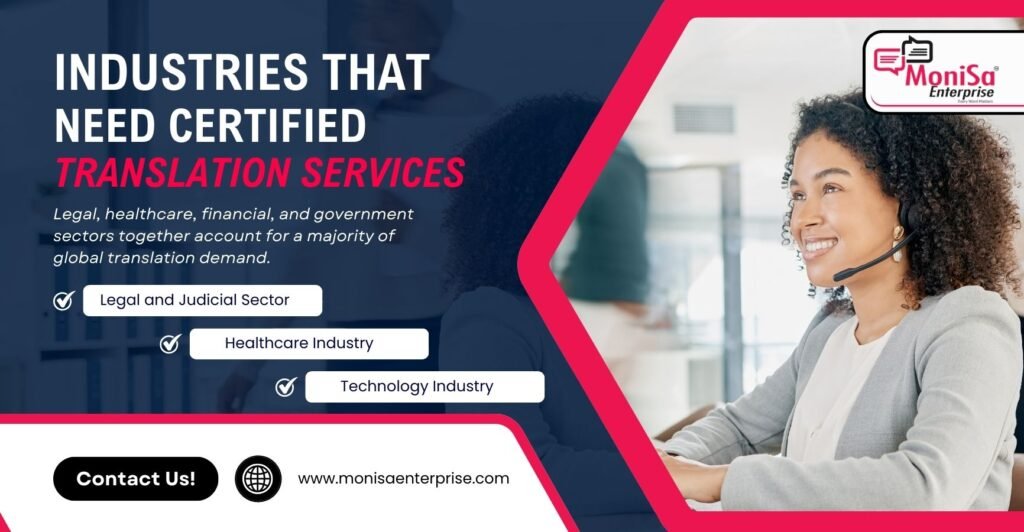
Industries That Need Certified Translation Services
Certified translation is required in sectors where documents must carry legal, regulatory, or administrative validity across languages. Unlike general translation, certified translations include a formal declaration confirming that the translated document accurately reflects the original. This requirement appears most often in industries where documentation must be accepted by courts, regulators, government authorities, or international institutions. Market analyses show that legal, healthcare, financial, and government sectors together account for a majority of global translation demand, largely because these industries depend on highly regulated documentation.
Legal and Judicial Sector (≈22%)
The legal industry represents one of the largest users of certified translation services, accounting for around 22% of the global translation market. Law firms, multinational companies, and courts rely on certified translations because legal language must remain precise across jurisdictions. Even small wording differences can alter contractual meaning or legal interpretation.
Certified translations are commonly required for contracts, arbitration documents, intellectual property filings, and cross-border litigation. Patent applications and corporate agreements must often be submitted in multiple languages when companies operate internationally. As global trade and multinational legal disputes continue to increase, the demand for legally valid translated documentation has expanded significantly.
Healthcare and Pharmaceutical Industry (≈20–21%)
The healthcare and life sciences sector accounts for approximately 20–21% of specialized translation demand worldwide. Medical translation requires exceptional accuracy because mistakes can affect patient safety, regulatory approvals, or clinical outcomes.
Pharmaceutical companies and medical device manufacturers frequently require certified translation for clinical trial documentation, regulatory submissions, and patient consent forms. Hospitals also request certified translation of medical records when patients seek treatment abroad. As international clinical research and medical tourism grow, the healthcare sector continues to generate substantial demand for certified translation services.
Government, Immigration, and Public Administration (≈22%)
Government institutions are another major consumer of certified translation services, representing around 22% of translation demand in administrative contexts. Immigration authorities, courts, and civil registries often require officially certified translations before accepting documents submitted in foreign languages.
Immigration procedures frequently require certified translations of civil records such as birth certificates, marriage certificates, academic documents, and identity records. Governments also require certified translation for policy documentation, bilateral agreements, and international administrative communication. Rising global migration and international cooperation continue to increase demand in this sector.
Banking, Financial Services, and Insurance (≈15–19%)
The banking and financial services sector contributes roughly 15–19% of translation market demand, particularly for regulatory and compliance documentation. Financial institutions must maintain highly accurate multilingual records when operating across jurisdictions.
Certified translation is commonly required for financial statements, audit reports, investor disclosures, and regulatory filings submitted to authorities in different countries. Insurance companies also rely on certified translations for international policies and legal claims documentation. As financial markets become more globalized, multilingual compliance requirements continue to expand.
Media, Entertainment, and Intellectual Property (≈26%)
The media and entertainment sector accounts for around 26% of global language services demand, largely driven by international content distribution and licensing agreements. While most work in this industry involves localization, certain documents still require certified translation.
Film distribution contracts, intellectual property filings, and licensing agreements must often be translated and certified when media companies expand content into foreign markets. With the rapid growth of streaming platforms and international media partnerships, certified documentation plays an important role in protecting intellectual property rights.
Technology and Software Industry
Technology companies have become a major driver of translation demand, with over 70% of language service providers reporting increasing demand from tech firms. Software companies expanding internationally must often translate technical documentation and compliance reports for regulatory authorities.
Certified translation is particularly relevant for patent filings, licensing agreements, cybersecurity compliance documentation, and international regulatory submissions. As digital products and SaaS platforms operate across multiple countries, technology companies increasingly require accurate and legally valid multilingual documentation.
Education and Academic Institutions
Educational institutions generate consistent demand for certified translation, particularly in international admissions and credential verification. Universities and credential evaluation agencies require certified translations of academic documents submitted by foreign students.
Academic transcripts, diplomas, and professional certifications often need certified translation before they can be evaluated by universities or licensing bodies abroad. The growth of international student mobility has increased the volume of academic documentation requiring official translation.
Tourism and International Travel (≈17%)
The tourism and travel sector contributes around 17% of translation demand globally, reflecting the scale of international travel and cross-border tourism operations. While most translation in this industry focuses on marketing and localization, some documentation requires certification.
Travel insurance policies, tourism licensing agreements, and international operational contracts often require certified translation to maintain legal validity across jurisdictions. With more than a billion international travelers annually, multilingual documentation plays a key role in supporting global travel infrastructure.
How Do Language Translation Services Support Global Market Expansion?
Companies entering new markets must adapt their content linguistically and culturally. Translation services make this expansion possible by converting marketing, product documentation, and customer support materials into multiple languages.
For example, e-commerce companies launching products in India often localize product listings into Hindi, Tamil, Telugu, and Bengali. This multilingual approach increases accessibility and improves customer engagement.
Localization also improves digital visibility. Businesses implementing multilingual SEO strategies often see increased search traffic from regional audiences.
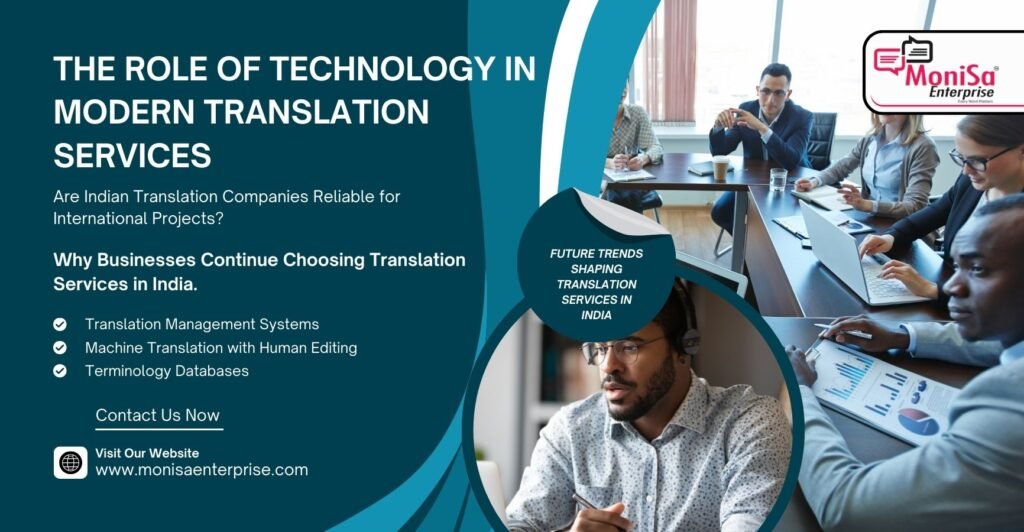
The Role of Technology in Modern Translation Services
Technology now plays a major role in improving translation efficiency and scalability.
- Translation Management Systems: TMS platforms centralize project management, enabling teams to handle large multilingual projects efficiently.
- Machine Translation with Human Editing: Many translation companies use AI-assisted translation tools followed by human review. This approach improves speed while maintaining linguistic accuracy.
- Terminology Databases: Terminology management ensures that key terms remain consistent across documents, particularly in technical or legal projects.
Cost Comparison: Translation Services in India vs Global Markets
| Region | Average Translation Cost (per word) |
|---|---|
| United States | $0.18 – $0.30 |
| Europe | $0.14 – $0.25 |
| India | $0.06 – $0.15 |
Lower costs do not necessarily indicate lower quality. Many professional translation companies in India work with certified translators and follow international quality standards such as ISO 17100.
The cost advantage allows global businesses to scale multilingual content production more efficiently.
Are Indian Translation Companies Reliable for International Projects?
Many Indian translation providers work with global clients across industries such as technology, healthcare, finance, and e-commerce. Large localization firms maintain distributed translator networks that cover hundreds of language pairs.
Reliability often depends on the company’s workflow structure. Firms with dedicated project managers, quality assurance teams, and standardized processes typically deliver consistent results.
Companies should review case studies, client references, and portfolio samples before choosing a provider.
Future Trends Shaping Translation Services in India
India’s translation industry is expanding rapidly as technology, digital platforms, and globalization increase the need for multilingual communication. The following trends are actively driving growth in translation and localization services across industries.
AI-Assisted Localization
Artificial intelligence is transforming translation workflows. Businesses now use AI-powered machine translation systems to process large volumes of content quickly while human translators handle editing and quality assurance. This hybrid approach reduces turnaround time and lowers costs while maintaining accuracy. Many global companies already integrate AI tools into their localization pipelines to support multilingual product launches.
Multilingual Content Marketing
Companies actively invest in multilingual digital marketing to reach regional audiences. Businesses translate websites, e-commerce listings, product manuals, blogs, and social media campaigns into Indian languages to improve engagement and customer trust. Studies show that consumers are more likely to purchase products when information appears in their native language, which encourages brands to expand localization efforts.
Rapid Growth of Regional Internet Users
India’s internet population is increasingly dominated by non-English users. Industry reports show that Indian-language internet users already outnumber English users online. With affordable smartphones and low-cost data plans bringing millions of new users online each year, platforms must provide content in languages such as Hindi, Bengali, Tamil, Telugu, and Marathi. This shift directly increases demand for translation across digital platforms.
Expansion of E-commerce Localization
India’s e-commerce sector continues to grow in tier-2 and tier-3 cities where regional languages dominate. Online marketplaces and digital payment platforms translate product descriptions, customer support materials, and mobile apps into local languages to improve accessibility and boost conversions.
Growth of OTT and Media Localization
Streaming platforms are rapidly expanding multilingual content. Movies, series, and documentaries now require subtitles, dubbing, and script translation in multiple Indian languages. The rapid growth of OTT platforms has created strong demand for audiovisual translation services.
Government and Public Sector Digitization
Government initiatives focused on digital governance require translation of official documents, public service portals, and policy information into multiple Indian languages. This push for linguistic accessibility is expanding the need for professional translation across government and public sector communication.
Demand for Industry-Specific Translation
Industries such as healthcare, legal services, finance, and technology increasingly require specialized translation. Companies need accurate translation of regulatory documents, contracts, medical materials, and technical manuals to comply with regulations and reach multilingual users.
Why Businesses Continue Choosing Translation Services in India
India has emerged as a major destination for professional translation services because it combines linguistic diversity, technological expertise, and cost efficiency. Companies operating in global markets increasingly rely on Indian translation providers to handle multilingual communication across documents, digital platforms, and media content.
For businesses expanding internationally or entering India’s multilingual market, choosing the right translation partner can significantly impact communication accuracy, brand reputation, and market reach. By evaluating industry expertise, language coverage, and technological capabilities, organizations can identify the most suitable translation service providers to support their global growth.