Advanced Linguistic Solutions— LQA, Terminology, and Linguistic Validation
Advanced linguistic programs require more than translation. When product terms drift between markets, when LQA audits flag recurring errors, or when terminology governance breaks down across 20+ languages, the problem is operational — not linguistic. MoniSa delivers structured LQA, terminology management, linguistic validation, and multilingual content auditing across 300+ languages with ISO-certified quality controls.
300+ Languages | ISO 9001 | ISO 27001 | ISO 17100
When teams come to us
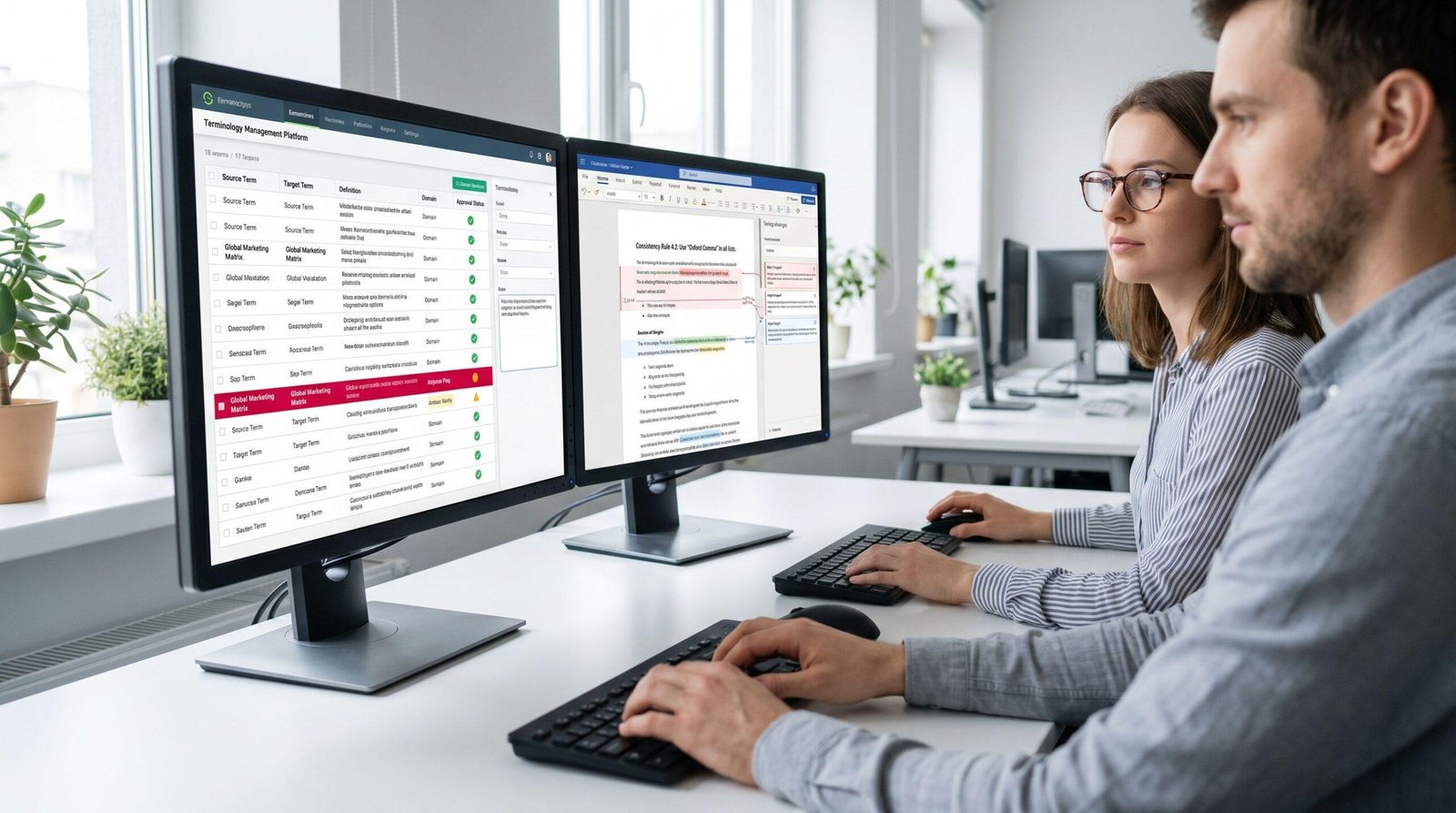
Terminology inconsistency across markets — product terms drift between translators, and different reviewers apply different glossaries to the same content
LQA gaps causing rework — delivered content fails quality audits, but the scoring criteria were never calibrated across reviewers
Linguistic validation is ad hoc — in-market testing happens after launch instead of before, and bugs surface as user complaints
No structured evaluation framework — quality is judged subjectively, with no MQM-based scoring or inter-annotator agreement tracking
Content audits reveal inconsistencies — multilingual assets accumulated over years contain conflicting terminology, outdated phrasing, and untranslated segments
Who this is for
Localization Manager
You need a partner who can run structured LQA programs with calibrated reviewers and standardized scoring, not ad hoc quality spot-checks.
QA Lead / Linguistic Quality Manager
You need MQM-based error typologies, inter-annotator agreement monitoring, and corrective action workflows that feed back into production.
Product Manager (Internationalization)
You need linguistic validation and in-context testing before launch to catch UI truncation, cultural mismatches, and functional string errors.
VP of Internationalization / Global Content
You need terminology governance that scales across 20+ markets with enforced glossaries, audit trails, and measurable consistency metrics.
Advanced linguistic services we deliver
Linguistic Quality Assurance (LQA)
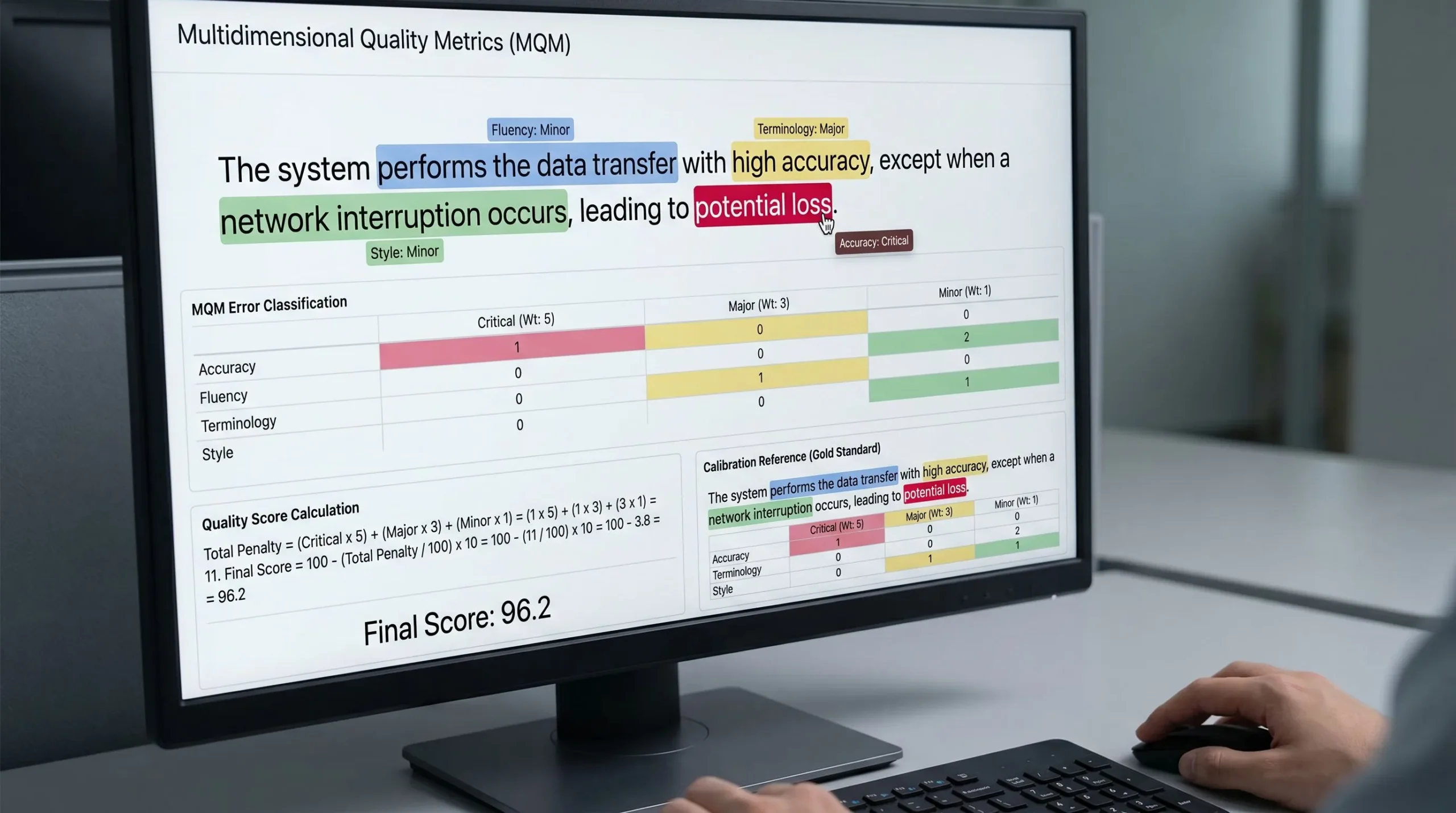
Structured LQA using MQM (Multidimensional Quality Metrics) error typology. Reviewers are calibrated against gold-standard samples before scoring begins. Error categories — accuracy, fluency, terminology, style, locale conventions — are weighted by content type and client priority. Scores are tracked per linguist, per language, and per batch.
Terminology Management and Glossary Creation
Glossary creation, validation, and enforcement for domains with no existing reference material or for programs where terminology has drifted across vendors. Includes term extraction, domain-expert validation, do-not-translate lists, and TMS integration where supported. For rare languages, terminology is built from scratch with community-level subject-matter experts.
Linguistic Validation and Testing
In-context review of translated UI strings, app content, and software interfaces. Catches truncation, cultural mismatches, placeholder errors, and formatting issues that standard translation review misses. Validation covers functional correctness, not just linguistic accuracy.
Language Assessment and Evaluation
Structured evaluation of linguist competence, translation quality, or model output accuracy. Includes test design, rubric creation, scorer calibration, and inter-annotator agreement measurement. Used for vendor qualification, linguist onboarding, and AI output benchmarking.
Multilingual Content Auditing
Systematic review of existing multilingual content assets for terminology consistency, style adherence, completeness, and accuracy. Identifies gaps, contradictions, and outdated translations across language versions. Delivers prioritized fix lists with severity scoring.
Service comparison
| Service | When to Use | Deliverable | Languages | Turnaround |
|---|---|---|---|---|
| LQA (MQM-based) | Post-translation quality scoring with calibrated reviewers | MQM error report, linguist scorecards, corrective action log | 300+ | 2–5 days per batch |
| Terminology Management | New domain, new market, or terminology drift across vendors | Validated glossary, DNT list, TMS-ready termbase | 300+ | 1–2 weeks per language set |
| Linguistic Validation | Pre-launch UI/UX review of translated software or apps | Bug report with screenshots, severity ratings, fix recommendations | 300+ | 3–7 days per language |
| Language Assessment | Vendor qualification, linguist screening, AI output evaluation | Scored assessments, IAA metrics, pass/fail recommendations | 300+ | 1–2 weeks |
| Content Auditing | Legacy content cleanup, post-migration consistency check | Audit report with severity-ranked fix list per language | 300+ | 1–3 weeks depending on volume |
How our linguistic workflow works
step 1
Scope and define
Content type, languages, quality framework, error typology weights, and success thresholds are defined before any reviewer touches the content. For LQA, this means agreeing on MQM categories, severity weights, and pass/fail thresholds. For terminology work, this means identifying source domains and validation authorities.
step 2
Calibrate
Reviewers score a calibration set of pre-annotated samples. Inter-annotator agreement is measured. Reviewers below the 80% agreement threshold are retrained or replaced before production begins. Calibration is not optional — it runs on every program.
step 3
Execute
Production scoring, terminology extraction, validation testing, or content auditing runs in structured batches. Each batch has defined scope, assigned reviewers, and quality checkpoints. Progress is tracked against the production schedule.
step 4
Review and score
Batch results are reviewed against the defined framework. LQA scores are computed per linguist and per language. Terminology deliverables are validated by domain experts. Validation bugs are severity-rated. Content audit findings are prioritized.
step 5
Report and iterate
Deliverables include structured reports with actionable findings, not summaries. Error trends, linguist performance data, and corrective actions are shared on cadence. For ongoing programs, findings feed back into glossary updates, reviewer calibration, and process adjustments.
Multilingual linguistic services at rare-language scale
languages available. LQA, terminology, and linguistic validation services extend to the same rare and ultra-low-resource languages MoniSa covers for translation. Languages we have delivered linguistic programs in include: Batak Karo, Pangasinan, Santali, Sylheti, Maranao, Banjar, Moroccan Arabic, Ahirani, Marshallese, Hmong, Hawaiian, Maori, Palauan, and Tahitian.
257,000
words across 8 rare languages spanning 4 scripts delivered in 10 days at 99.8% accuracy
789,000
words of translation and evaluation across 10+ rare languages in 25 days at 99.5% linguistic accuracy
Rare and ultra-low-resource languages we have delivered in production AI programs include: Chittagonian, Dzongkha, Herero, Highland Quichua, Marshallese, Hmong, Hawaiian, Maori, Palauan, Tahitian, Fanti, Chadian Arabic, Tok Pisin, and Teso.

Quality control
LAYER 1
LAYER 2
LAYER 3
Pre-production
Reviewer screening against domain and language requirements. Calibration against gold-standard annotated samples. Pilot batch of 500-1,000 units scored and reviewed before full production begins. Reviewers who fall below inter-annotator agreement thresholds are retrained or replaced.
In-production
10-20% sampling on every batch. Inter-annotator agreement monitored at 80-85% threshold throughout the program. Disagreements are adjudicated by a senior reviewer. Error trends are tracked in real time and flagged when patterns emerge.
Layer 3: Post-delivery
MQM-based scoring with pass threshold at 94% and corrective action triggered at 85-93%. Final quality reports include error distribution by category, linguist-level performance data, and trend analysis across batches. Corrective actions are logged and verified in the next production cycle.
LAYER 1
Pre-production
Reviewer screening against domain and language requirements. Calibration against gold-standard annotated samples. Pilot batch of 500-1,000 units scored and reviewed before full production begins. Reviewers who fall below inter-annotator agreement thresholds are retrained or replaced.
LAYER 2
In-production
10-20% sampling on every batch. Inter-annotator agreement monitored at 80-85% threshold throughout the program. Disagreements are adjudicated by a senior reviewer. Error trends are tracked in real time and flagged when patterns emerge.
LAYER 3
Post-delivery
Final audit against calibration benchmarks with inter-annotator agreement (IAA) scoring. Error patterns are logged per annotator and per language.
Terminology governance: Glossaries are enforced through TMS integration where available and manually verified in every batch for rare-language pairs without TMS support.
Governance, security, and delivery assurance
ISO certified: ISO 9001:2015 (Quality Management), ISO 27001:2013 (Information Security), ISO 17100:2015 (Translation Services). All three certifications apply to linguistic quality programs.
White-label compliance: GDPR-aligned data handling across all linguistic workflows. NDAs signed with every reviewer. Access controls scoped by project role and language pair.
Security posture: Encrypted data in transit and at rest. No content stored beyond project lifecycle unless contractually required. Reviewer access revoked at project close.
SLA readiness: Encrypted data in transit and at rest. No content stored beyond project lifecycle unless contractually required. Reviewer access revoked at project close.
Proof
An Rare-language TEP across 8 languages and 4 scripts that most vendors could not staff
Problem –
A global technology company required translation, editing, and proofreading across 8 rare languages (Batak Karo, Pangasinan, Santali, Sylheti, Maranao, Banjar, Moroccan Arabic, Ahirani) spanning 4 writing systems. Standard sourcing could not produce qualified translators for any of the required pairs.
What we did –
MoniSa sourced linguists for all 8 pairs through community networks, built terminology from scratch, and delivered in structured batches with cross-language consistency checks and calibrated quality scoring.
Result –
257,000 words delivered in 10 days at 99.8% accuracy with minimal revisions.
Translation and linguistic evaluation across 10+ rare languages including Marshallese, Hmong, and Hawaiian
A technology company needed translation and evaluation across languages including Marshallese, Hmong, Hawaiian, Maori, Palauan, and Tahitian. Finding qualified linguists and evaluators in these languages takes months through standard sourcing channels.
What we did –
MoniSa sourced rare-language linguists through community networks, built evaluation protocols from scratch, calibrated scorers, and delivered in structured batches with cross-language consistency checks.
Result –
789,000 words delivered in 25 days at 99.5% linguistic accuracy across 10+ rare languages.
Frequently asked questions
What is linguistic quality assurance (LQA) and how does it differ from proofreading?
LQA is a structured quality scoring process using standardized error typologies like MQM. Unlike proofreading, which fixes errors in a single pass, LQA measures quality numerically across categories (accuracy, fluency, terminology, style, locale). It produces scorecards and error trend data that feed back into production. Proofreading is a correction step. LQA is a measurement and governance step.
How do you calibrate reviewers for LQA programs?
Every reviewer scores a calibration set of pre-annotated samples before production begins. Inter-annotator agreement is measured against a gold standard. Reviewers below the 80% agreement threshold are retrained or reassigned. Calibration is repeated when new reviewers join mid-program or when error typology weights change.
Can you build terminology from zero for a domain with no existing glossary?
Yes. MoniSa builds glossaries, do-not-translate lists, and style guides from zero for domains with no usable reference material. Term extraction runs against source content. Validation is done with domain authorities and, for rare languages, community-level subject-matter experts. Completed termbases are delivered in TMS-compatible formats.
What does linguistic validation cover beyond translation review?
Linguistic validation tests translated content in its final context — the UI, the app, the software interface. It catches truncation, placeholder errors, date/number format mismatches, cultural inappropriateness, and functional string failures that translation review cannot detect because reviewers typically work in bilingual text files, not in the live product.
How do you handle LQA for rare languages where qualified reviewers are scarce?
MoniSa sources reviewers through community networks, not freelancer marketplaces. For languages with fewer than 50 qualified linguists worldwide, sourcing starts at the diaspora, academic, and institutional level. Calibration protocols are adapted for smaller reviewer pools while maintaining scoring rigor. We have delivered linguistic quality programs in Marshallese, Hmong, Hawaiian, Maori, and other ultra-low-resource languages.
What certifications does MoniSa hold for linguistic quality work?
ISO 9001:2015 (Quality Management), ISO 27001:2013 (Information Security), and ISO 17100:2015 (Translation Services). ISO 17100 is the international standard for translation service providers and covers the competence of linguists, the revision process, and quality assurance workflows.
Related resources
Ready to talk?
ISO 9001 | ISO 27001 | ISO 17100 certified. 300+ languages. MQM-based scoring with calibrated reviewers.