Multilingual Subtitle Translation for OTT, Film, and Corporate Video
A streaming platform launched 120+ hours of content into 7 rare African and Southeast Asian languages — subtitles, dubbing, and metadata — in 15 days. Zero compliance issues. Zero post-delivery edits on that delivery. That is what happens when subtitle translation is built on documented QC methodology rather than crowdsourced guesswork. MoniSa delivers multilingual subtitle translation across 300+ languages with platform-specific compliance, SDH accessibility, and a QC process that catches timing, linguistic, and technical errors before your content goes live.
What we subtitle
OTT and streaming content
Series, films, documentaries, and original programming for platforms including Netflix, Amazon Prime Video, Disney+, and regional streaming services. Subtitle files are delivered in platform-required formats (SRT, VTT, TTML, DFXP) with compliance to each platform’s timing, character limit, and style specifications.
Film and broadcast
Feature films, short films, broadcast television, and festival submissions. Subtitle translation for theatrical and broadcast distribution follows industry-standard timing and reading speed parameters.
Corporate and training video
Internal communications, product demos, training modules, webinars, and investor presentations. Corporate subtitle translation maintains brand terminology consistency and supports multi-language rollouts on tight schedules.
E-learning and educational content
Course videos, lecture recordings, assessment walkthroughs, and tutorial content. E-learning subtitles require consistent terminology across modules and reading speeds appropriate to the learner audience.
Marketing and social media video
Ad campaigns, social media clips, product launches, and brand content. Subtitle translation for marketing content often involves transcreation — adapting the message for cultural impact rather than literal accuracy.
Languages and coverage
Subtitle translation available in 300+ languages. Our coverage spans major commercial languages (Spanish, French, German, Japanese, Korean, Portuguese, Arabic, Mandarin) through rare and indigenous language pairs where qualified subtitlers are difficult to source.
For dubbing and voice-over to complement subtitles, we cover 60+ languages with 700+ voice resources across 30+ studios. For projects that need subtitling, dubbing, and metadata localization as a combined deliverable, see our multimedia services page.
Rare language subtitling
We source subtitlers for languages that most providers cannot cover. In a recent OTT project, we delivered subtitles in 7 rare African and Southeast Asian languages — including pairs where fewer than 10 active qualified subtitlers exist globally. Sourcing for rare languages uses diaspora networks, community organizations, and academic partnerships, not marketplace scraping.
OTT platform compliance
Each streaming platform has specific subtitle requirements. Delivering files that fail compliance checks causes rejection, re-work, and launch delays. We build platform compliance into the production process, not as a post-delivery check.
| Requirement | Netflix Timed Text | Amazon Prime Video | Disney+ / Hulu | MoniSa Standard |
|---|---|---|---|---|
| Max characters per line | 42 | 42 | 42 | 42 |
| Max lines per subtitle | 2 | 2 | 2 | 2 |
| Reading speed (adult) | 17 chars/sec | 17 chars/sec | 17 chars/sec | 17 chars/sec |
| Reading speed (children) | 13 chars/sec | 13 chars/sec | 13 chars/sec | 13 chars/sec |
| Min display time | 0.833s (20 frames at 24fps) | 1s | 1s | 1s |
| Max display time | 7s | 7s | 7s | 7s |
| File format | DFXP/TTML | SRT/TTML | SRT/TTML | Per platform |
Our QC process validates every subtitle file against the target platform’s requirements before delivery. Files that would fail platform ingestion are caught and corrected during production, not after submission.
QC methodology for subtitle translation
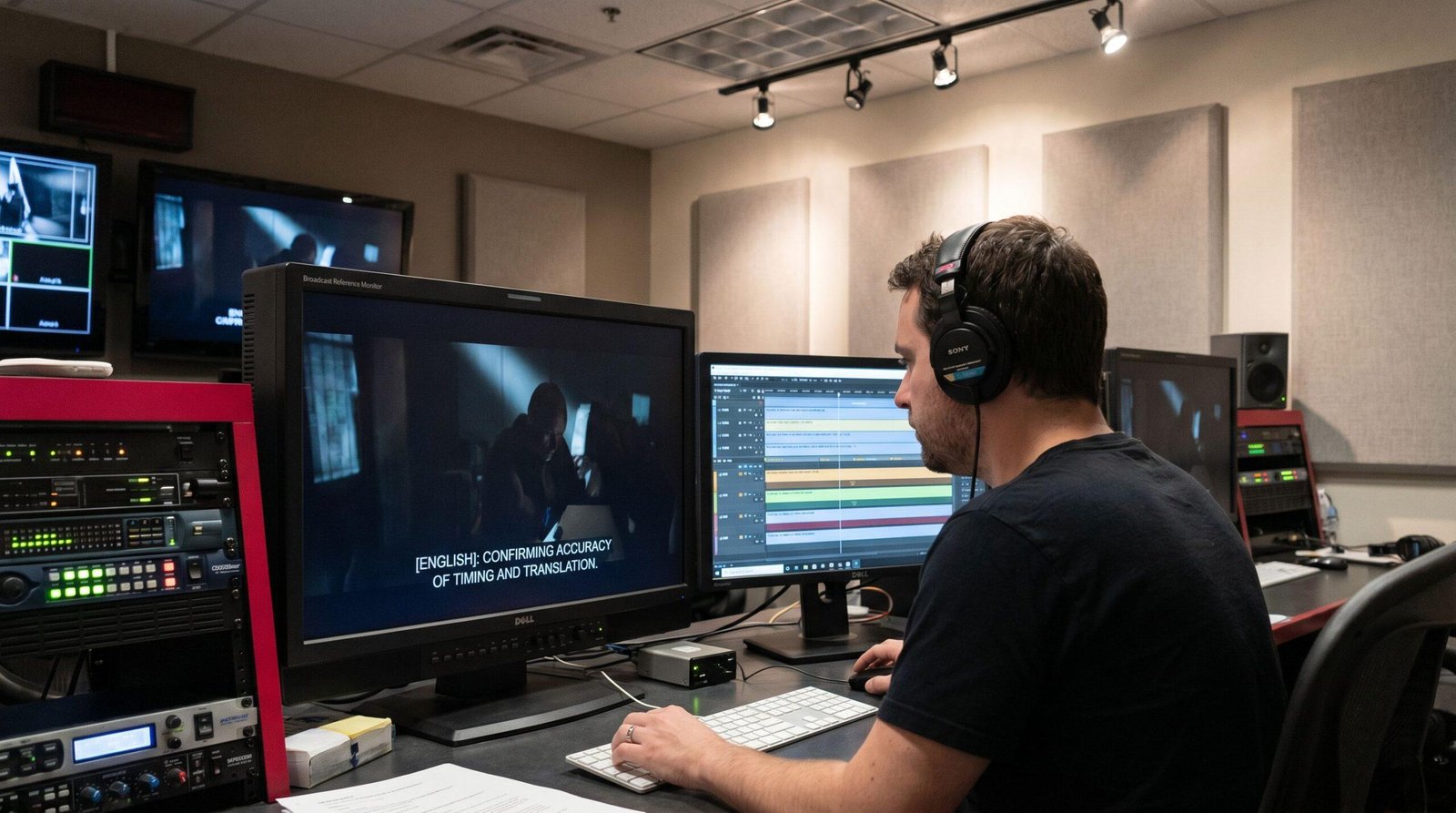
Our subtitle QC runs four checks on every file. This is not a checklist in a PDF — it is a documented, enforced methodology with defined pass/fail thresholds and error severity weightings.
1. Timing QC
Maximum deviation of 200ms from speech onset. Minimum display time of 1 second, maximum of 7 seconds. Reading speed verified at 17 characters per second for adult content and 13 characters per second for children’s content. Timing overlaps between consecutive subtitles are flagged and corrected.
2. Linguistic QC
Bilingual L2/L3 reviewer checks translation accuracy, fluency, and cultural appropriateness. Terminology consistency is verified against project glossaries. Register and tone are matched to the content genre.
3. Technical QC
42 characters per line maximum, 2 lines per subtitle maximum. UTF-8 encoding verified. Formatting validated (italics for off-screen speakers, song lyrics). Line breaks placed at logical phrase boundaries, not mid-word or mid-clause.
4. SDH and accessibility QC
Speaker identification labels verified for accuracy and consistency. Sound effects and music descriptions included and properly formatted. ADA and WCAG compliance checked for subtitles intended as accessibility features.
Error severity and pass criteria
| Error Category | Critical (x5 weight) | Major (x2 weight) | Minor (x1 weight) |
|---|---|---|---|
| Timing | More than 1s off speech | More than 500ms off | More than 200ms off |
| Accuracy | Meaning reversed or fabricated | Partial meaning loss | Slight nuance missed |
| Technical | Wrong encoding or corrupt file | Line break mid-word | Inconsistent formatting |
| SDH | Speaker ID missing entirely | Incorrect speaker ID | Inconsistent formatting |
Pass threshold: 94%+ weighted quality score with zero critical errors. Files scoring 85-93% receive corrective feedback and re-QC. Below 85% triggers reassignment and documented root cause analysis.
SDH and accessibility subtitling
Subtitles for the Deaf and Hard of Hearing (SDH) go beyond dialogue translation. SDH includes speaker identification, sound effect descriptions, music characterization, and environmental audio cues that hearing viewers perceive without subtitles.
Our SDH subtitling follows ADA and WCAG guidelines and is delivered as a standard option alongside dialogue-only subtitles. For streaming platforms, SDH and CC (closed caption) tracks are produced in the platform-specified format.
- Speaker identification with consistent labeling conventions
- Sound effects described in brackets: [door slams], [phone buzzing]
- Music characterized by genre or mood: [upbeat jazz], [tense orchestral score]
- Off-screen audio attributed and labeled
- Formatting consistent with platform SDH style guides
Production outcomes
OTT streaming — 7 rare languages, 120+ hours, 15 days
A major OTT platform needed subtitling, dubbing, and metadata localization for 120+ hours of content into 7 rare African and Southeast Asian languages. Languages included pairs where fewer than 10 active qualified linguists existed globally. MoniSa delivered all assets in 15 days with zero compliance issues and zero post-delivery edits.
Why this project succeeded: Pre-vetted rare-language subtitlers sourced through diaspora and community networks. QC methodology applied to every file before delivery. Platform compliance built into the production workflow, not checked after the fact.
Performance benchmarks
| Content Type | Typical Volume | Turnaround | QA Rework Rate |
|---|---|---|---|
| Subtitling (rare language) | 1 hour video | 24-48 hours | Less than 2% |
| Subtitling (common language) | 1 hour video | 12-24 hours | Less than 1.5% |
| Multi-format (subtitles + dubbing + metadata) | 10+ hours | 3-5 business days | Less than 2% |
Tools and workflow
Our subtitle production uses industry-standard tools with automated validation layers:
- Subtitling tools: Aegisub, VisualSubSync, Subtitle Edit, Subtitle Horse, Filmora 9
- Automated validation: SRT/VTT/TTML structure verification, timing overlap detection, character limit enforcement, encoding validation
- Audio/video tools: Audacity, Adobe Audition, Sound Forge, Pro Tools (for projects combining subtitles with dubbing/VO)
- Delivery formats: SRT, VTT, TTML, DFXP, STL, ASS/SSA — per platform specification
Frequently asked questions
Can you subtitle into languages that most providers cannot cover?
Yes. Our coverage includes 300+ languages, and we source subtitlers for rare and indigenous language pairs through diaspora networks, community organizations, and academic partnerships. For a recent project, we delivered into 7 rare African and Southeast Asian languages where global subtitler availability was extremely limited.
Do you deliver files ready for Netflix / Amazon / Disney+ ingestion?
Yes. Files are produced and QC’d against each platform’s specific requirements — format, timing, character limits, reading speed, and style conventions. Files that would fail platform ingestion checks are caught and corrected during production.
What is the difference between subtitles, closed captions, and SDH?
Subtitles translate dialogue for viewers who hear the audio but do not understand the source language. Closed captions (CC) transcribe all audio — dialogue, sound effects, music — for deaf or hard-of-hearing viewers, typically in the same language as the audio. SDH (Subtitles for the Deaf and Hard of Hearing) combines translation with accessibility features: translated dialogue plus speaker IDs, sound effects, and music descriptions.
Can you handle high-volume subtitle projects on tight deadlines?
Yes. Our delivery model scales through team expansion while maintaining consistency via shared glossaries, terminology databases, and dedicated QA reviewers. For the 120+ hour OTT project referenced above, the full scope was delivered in 15 days across 7 languages.
Do you provide dubbing and voice-over alongside subtitles?
Yes. We deliver subtitling, dubbing, voice-over, and metadata localization as a combined service. 60+ languages for dubbing and voice-over, 700+ voice resources, 30+ studios. See our multimedia services page or dubbing services for details.
What quality score should we expect?
Our production pass threshold is 94%+ on a weighted MQM-based quality score with zero critical errors. Industry rework rates for rare-language subtitling average 10-12%. Our rate is consistently below 2% on comparable projects.
How do you price subtitle translation?
Pricing depends on language pair, content volume (measured in minutes of video), complexity (technical content vs dialogue-driven), SDH requirements, and turnaround time. Contact us with your project scope for a quote.
Need subtitles that pass platform compliance the first time?
Send us the content scope: languages, total runtime, platform targets, SDH requirements, and deadline. We will provide a quote with timeline and team composition within 48 hours.