A patient arrives at the emergency department at 2 AM. She speaks Tigrinya. The nearest certified medical interpreter is 90 miles away. Without language access, clinical staff are guessing at symptoms, allergies, and medication history.
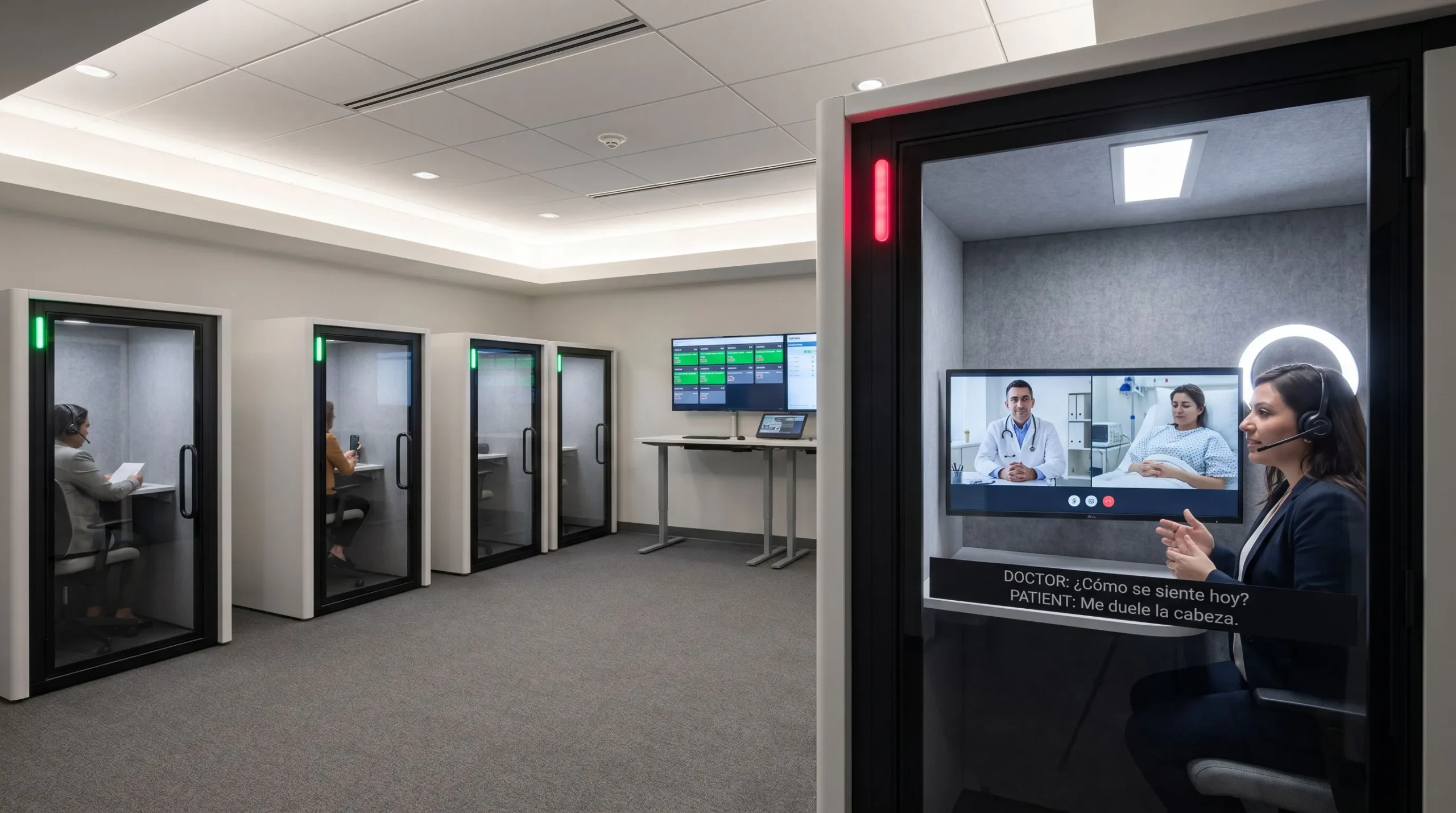
Video Remote Interpretation solves this. In under 60 seconds, a certified interpreter appears on screen, reads the patient’s facial cues, and enables a clinically accurate conversation. No travel time. No scheduling delays. No guesswork.
This guide covers everything healthcare organizations need to deploy VRI correctly: the regulatory framework, when VRI is the right choice (and when it is not), technical infrastructure, interpreter quality standards, and the most common implementation failures.
What VRI Is and How It Works in Healthcare
VRI connects patients and providers with a certified interpreter through a live, secure video link. Unlike over-the-phone interpretation (OPI), VRI captures visual context: facial expressions, gestures, physical demonstrations, and emotional cues that are critical in clinical settings.
The workflow is straightforward:
- A clinician initiates a video session from a tablet, mobile cart, or workstation.
- The system routes the request to a qualified interpreter based on language pair, clinical specialty, and availability.
- The interpreter joins the session, typically within 30 to 60 seconds for high-demand languages.
- The session is logged, and documentation feeds back into the patient record. For written patient materials, certified translation services handle discharge documents, consent forms, and medication guides.
VRI is used across emergency departments, inpatient rounds, mental health evaluations, discharge planning, specialty consultations (oncology, cardiology, surgery), and telehealth appointments. Any encounter where a clinician needs to observe the patient while communicating through an interpreter is a strong VRI use case.
Regulatory Requirements
Healthcare language access is not optional. Multiple overlapping mandates require it.
United States
- Title VI, Civil Rights Act (1964): Any facility receiving federal funding must provide meaningful language access. This covers virtually every hospital that accepts Medicare or Medicaid.
- ACA Section 1557: Extends nondiscrimination protections explicitly to language access. Facilities must ensure that limited English proficiency (LEP) patients receive qualified interpreter services–not ad hoc bilingual staff or family members.
- ADA: Requires effective communication accommodations, including for individuals who are deaf or hard of hearing. VRI is an accepted accommodation method when specific technical standards are met (28 CFR 36.303).
- HIPAA: All VRI platforms must comply with the Privacy Rule. This means end-to-end encryption, Business Associate Agreements (BAAs) with the VRI vendor, access controls, and session audit trails.
International
- UK: The Equality Act (2010) and NHS Accessible Information Standard mandate interpreter access across NHS-funded services.
- EU: The Charter of Fundamental Rights (Article 21) and the Cross-Border Healthcare Directive (2011/24/EU) establish multilingual access requirements.
When to Use VRI vs. OPI vs. On-Site Interpreters
Each interpretation mode has a clear clinical fit. Choosing wrong costs time, accuracy, or both.
| Scenario | Best Mode | Why |
|---|---|---|
| Emergency triage, trauma assessment | VRI | Visual cues are critical; on-site interpreter unlikely to be available fast enough |
| Mental health evaluation, behavioral health | VRI | Facial expressions and body language are part of the clinical assessment |
| Informed consent discussions | VRI or On-Site | Complex, high-stakes communication requiring visual confirmation of understanding |
| Scheduling, billing inquiries, prescription refills | OPI | Administrative; audio-only is sufficient and faster to connect |
| Physical therapy demonstrations, wound care instructions | On-Site | Interpreter may need to be physically present to observe and describe hands-on procedures |
| Telehealth appointments | VRI | Interpreter joins the existing video session; no additional infrastructure needed |
| Discharge planning with medication review | VRI | Interpreter can see medication packaging, written instructions, and patient reactions |
The general rule: if visual context improves clinical accuracy, use VRI. If the interaction is purely administrative, OPI is faster and cheaper. If the interpreter needs to be in the room physically, nothing substitutes for on-site.
Technical Requirements
VRI fails when infrastructure fails. These are non-negotiable:
- Bandwidth: Minimum 1.5 Mbps symmetrical per concurrent session. Test during peak hours, not during maintenance windows. Wi-Fi dead zones in patient rooms kill VRI adoption.
- Hardware: Dedicated VRI tablets or mobile carts at the point of care. Shared workstations create bottlenecks and infection control concerns.
- Platform security: HIPAA-compliant with end-to-end encryption, role-based access controls, and session audit logging. The vendor must sign a BAA.
- EHR integration: Session data (language, interpreter ID, duration, encounter notes) should feed directly into the patient’s electronic health record. Manual documentation creates gaps.
- Redundancy: A fallback to OPI when video connectivity drops. Sessions will drop. Having an automatic failover prevents clinical delays.
Quality Standards for Medical VRI
A video link to an unqualified interpreter is worse than no interpreter at all. It creates a false sense of communication accuracy.
Medical VRI interpreters must meet these standards:
- Certification: National Board of Certification for Medical Interpreters (NBCMI) or Certification Commission for Healthcare Interpreters (CCHI). State-level certifications where applicable.
- Clinical terminology fluency: Interpreters working in oncology, cardiology, mental health, or surgical settings need domain-specific vocabulary, not general language proficiency.
- Cultural competence: Understanding cultural attitudes toward pain reporting, mental health, end-of-life decisions, and consent. Misreading cultural context leads to misdiagnosis.
- Confidentiality protocols: Interpreters must operate in private, soundproofed environments with no unauthorized listeners. HIPAA applies to them directly.
- Fatigue management: High-volume emergency settings burn interpreters out. Session rotation and workload caps are quality controls, not luxuries.
Common Implementation Mistakes
Most VRI programs that underperform share the same failure patterns:
- No clinical workflow alignment. Dropping VRI hardware into departments without redesigning the encounter workflow. Staff do not know when or how to initiate a session.
- Choosing the cheapest platform. Non-HIPAA-compliant vendors, poor video quality, or slow interpreter connect times. Clinical staff revert to ad hoc solutions within weeks.
- Skipping staff training. Nurses and physicians need hands-on practice, not a one-time email. Include VRI in clinical onboarding and annual competency reviews.
- Ignoring EHR integration. When sessions are not documented in the patient record, compliance audits fail and continuity of care suffers.
- No utilization tracking. Without data on session volume by department, language, time-of-day, and connect time, you cannot identify coverage gaps or justify budget.
- Treating rare languages as afterthoughts. If your patient population includes speakers of Karen, Chuukese, Marshallese, or Rohingya, your VRI vendor must have certified capacity in those languages. Verify, do not assume.
MoniSa VRI Capability
MoniSa Enterprise delivers VRI and interpretation services across 300+ languages, including rare and indigenous languages that most providers cannot cover.
What that means operationally:
- Certified medical interpreters with NBCMI, CCHI, and equivalent international credentials across clinical specialties.
- ISO 9001, ISO 27001, and ISO 17100 certified operations, covering quality management, information security, and translation service standards.
- Extended coverage hours with scheduling discipline that matches interpreter capacity to demand patterns, including overnight and weekend coverage.
- HIPAA-compliant infrastructure with end-to-end encryption, BAA coverage, and session audit trails.
- Flexible deployment across emergency, inpatient, outpatient, and telehealth settings.
For healthcare organizations building or upgrading their language access program, the question is not whether to offer VRI. The mandates require it. The question is whether your current setup meets clinical accuracy standards, regulatory requirements, and patient experience expectations. Healthcare localization of patient-facing platforms and portals complements VRI by ensuring written digital content is also accessible.
Further Reading
- OPI for Enterprise Programs — the companion guide to phone-based interpretation at scale
- What Is Localization and Why It Matters — broader context on language services beyond interpretation
Build a VRI Program That Meets the Standard
MoniSa provides certified medical interpreters in 300+ languages with ISO-certified quality and HIPAA-compliant delivery. Explore our interpretation services or contact us to discuss your language access requirements.