What Each Term Actually Means
Translation
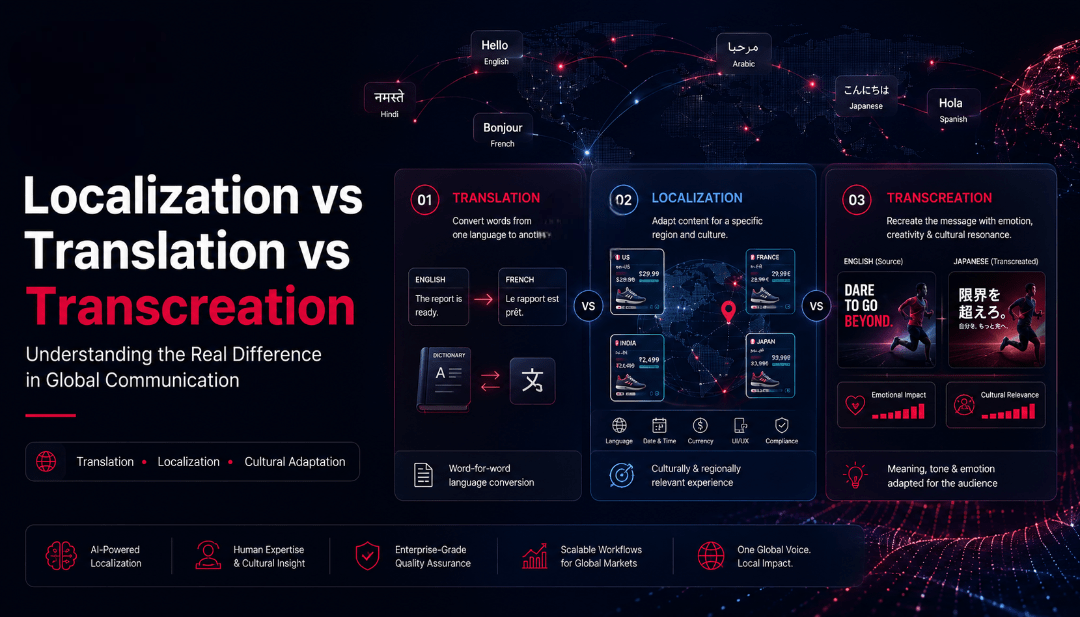
Translation converts text from one language to another while preserving the meaning, tone, and structure of the original. The source text is the authority. A good translation is accurate, complete, and natural in the target language, but it stays faithful to what the original says.
Best for: Legal contracts, technical documentation, medical records, patent filings, regulatory submissions, user manuals, scientific papers, financial reports. Content where accuracy and fidelity to the source are non-negotiable.
Example: A pharmaceutical company translating clinical trial protocols into 12 languages needs every term, dosage, and procedure instruction to match the English source exactly. Creative interpretation is not just unwanted; it is dangerous.
Localization
Localization adapts an entire product or experience for a specific market. It includes translation but goes further: adjusting date formats, currency, measurement units, images, color choices, layouts, legal requirements, and cultural references. The goal is to make the product feel native to the target market.
Best for: Software and apps, websites, e-commerce platforms, video games, e-learning courses, mobile applications. Any product that users interact with, where the experience needs to feel locally built.
Example: Localizing a mobile banking app for Japan means more than translating the interface text. It means adapting the layout for Japanese text density, changing date formats to the Japanese calendar system, adjusting address fields for Japanese postal structure, ensuring compliance with Japanese financial regulations, and modifying UI elements to match Japanese UX conventions.
Transcreation
Transcreation rebuilds a message from scratch for a new audience. The original content serves as a creative brief, not a source to translate. Transcreators (usually copywriters who work bilingually) create new content that achieves the same emotional impact and marketing objective in the target culture.
Best for: Advertising campaigns, brand slogans, marketing headlines, social media campaigns, brand voice content, taglines, emotional storytelling. Content where the feeling matters more than the literal meaning.
Example: Coca-Cola’s “Share a Coke” campaign required transcreation for every market. In China, the concept shifted from individual names to relationship titles (“Share a Coke with your classmate”) because Chinese culture emphasizes relationships over individual identity. The campaign objective stayed the same; the execution changed completely.
Side-by-Side Comparison
| Dimension | Translation | Localization | Transcreation |
|---|---|---|---|
| Primary goal | Accuracy to source | Native user experience | Equivalent emotional impact |
| Source text role | Authority (follow it) | Foundation (adapt it) | Creative brief (reimagine it) |
| Who does it | Professional translator | Translator + engineers + designers | Bilingual copywriter / creative team |
| Scope | Text only | Text + UI + formats + media + code | Message and concept |
| Creative freedom | Minimal | Moderate | High |
| Typical content | Legal, medical, technical, academic | Software, websites, apps, games | Ads, slogans, campaigns, brand copy |
| Quality standard | ISO 17100 (translation quality) | Functional testing + linguistic QA | Creative review + market testing |
| Pricing model | Per word or per page | Per project (includes engineering) | Per hour or per project |
| Relative cost | Baseline (1x) | 1.5-3x translation cost | 3-10x translation cost |
| Timeline | 1-2 days per 5,000 words | 1-4 weeks per product | 2-6 weeks per campaign |
When to Use Each Service
Choose Translation When:
- The content is factual, technical, or regulatory
- Accuracy to the source text is the primary requirement
- The content will be used in legal, medical, financial, or compliance contexts
- You need certified or notarized translations for official purposes
- The content does not rely on cultural references, humor, or emotional appeal
Choose Localization When:
- You are adapting a product (not just a document) for a new market
- Users will interact with the content in an interface
- Date formats, currencies, images, and layouts need to change
- The product needs to pass localization testing (functional + linguistic)
- You are launching software, an app, a game, or an e-commerce platform in new markets
Choose Transcreation When:
- The content is designed to persuade, entertain, or evoke emotion
- Literal translation would lose the intended effect
- You are adapting advertising, slogans, brand messaging, or campaign concepts
- The target audience has different cultural references than the source audience
- You need multiple creative options, not a single “correct” translation
Examples by Industry
Technology and SaaS
A SaaS company launching in Germany needs all three. The API documentation gets translation (accuracy is critical). The application interface gets localization (date formats, number separators, and UI layout adaptation for German text expansion of 20-30%). The marketing landing page gets transcreation (the value propositions need to resonate with German buying psychology, which is more risk-averse and detail-oriented than US buyers).
Healthcare and Pharma
Translation dominates: clinical trial protocols, informed consent forms, drug labels, patient information leaflets, and regulatory submissions all require precise, certified translation. Localization applies to patient-facing apps and digital health platforms. Transcreation is rare in healthcare, limited to patient education campaigns and public health messaging.
E-Commerce and Retail
Product descriptions typically need translation. The shopping platform needs localization (payment methods, shipping options, size charts, return policies). Marketing emails and seasonal campaigns need transcreation to match local buying seasons and cultural events that differ by market.
Gaming
Game UI and system text need localization (including string length constraints and character encoding). In-game dialogue and narrative need translation with heavy cultural adaptation. Marketing trailers and launch campaigns need transcreation to match each market’s gaming culture and platform preferences.
Media and Entertainment
Subtitle translation is primarily translation with tight timing and character constraints. Dubbing scripts require more adaptation, approaching transcreation for comedy, wordplay, and cultural references. Marketing materials and promotional content for each territory need full transcreation.
Cost and Timeline Comparison
Understanding cost drivers helps you budget realistically and avoid surprises:
Translation Costs
Priced per word or per page. Rates vary by language pair, specialization, and urgency. Common European languages cost less than rare or specialized pairs. Rush surcharges of 20-50% apply for urgent timelines. Machine Translation Post-Editing (MTPE) can reduce costs by 30-65% for suitable content types (technical, repetitive), but is not appropriate for creative, legal, or safety-critical content.
Localization Costs
Priced per project because the scope extends beyond text. A localization project includes linguistic translation, engineering (string extraction, file preparation, build integration), functional testing, and linguistic QA in context. Plan for 1.5-3x the cost of translation alone, depending on technical complexity.
Transcreation Costs
Priced per hour or per project, not per word. Transcreation requires bilingual creative professionals, not translators. Multiple creative options are typically presented for client selection. Plan for 3-10x translation cost. A single tagline transcreation can cost as much as translating an entire brochure, because the creative process, not the word count, drives the effort.
Timeline Factors
| Service | Typical Timeline | Key Dependencies |
|---|---|---|
| Translation (5,000 words) | 1-2 business days | Language pair availability, subject matter complexity |
| Translation (50,000 words) | 5-10 business days | Team size, terminology consistency requirements |
| Localization (mobile app) | 2-4 weeks | String count, number of languages, testing cycles |
| Localization (website, 50+ pages) | 4-8 weeks | CMS integration, multimedia, number of languages |
| Transcreation (campaign, 5 assets) | 2-4 weeks | Creative brief quality, review rounds, market count |
How MoniSa Handles All Three
Most companies engage separate vendors for translation, localization, and transcreation. This creates coordination overhead, inconsistent terminology, and finger-pointing when something goes wrong.
MoniSa Enterprise delivers all three services under a single project management structure, drawing from a network of tens of thousands of vetted linguists across 300+ languages and 4,500+ dialects. Here is what that means in practice:
Translation Under ISO 17100
Our translation workflow follows ISO 17100:2015 requirements: qualified translators, revisers, and a documented quality process. Every translator is a native speaker of the target language with verified domain expertise. We use TMS platforms (Phrase, MemoQ, Smartcat, XTM) for terminology management and translation memory, ensuring consistency across projects and reducing repeat costs.
On a recent project, we delivered 257,000 words across 8 rare languages (Batak Karo, Pangasinan, Santali, Sylheti, Maranao, Banjar, Moroccan Arabic, Ahirani) in 10 days with 99.8% accuracy on the completed project.
Localization With Technical Depth
Our localization projects cover websites, software, apps, e-learning, and games. We handle string extraction, file preparation, localization testing, and linguistic QA in context. Tools include SDL Trados, MemoQ, Alchemy Catalyst, SDL Passolo, and APSIC Xbench for localization verification.
We have delivered localization work for technology platforms including gaming, educational software, and mobile applications, with consistent quality maintained across multiple simultaneous language versions.
Transcreation With Cultural Expertise
Transcreation projects are staffed with bilingual copywriters, not translators. They receive a creative brief, not a source text. They deliver multiple options with back-translations and rationale for each creative direction. Our cultural expertise is particularly deep in South Asian, Southeast Asian, Middle Eastern, and African markets, where cultural nuance is most likely to trip up US- or European-centric campaigns.
Why One Partner for All Three
When a single team manages your translation, localization, and transcreation, terminology stays consistent across all content types. Your product documentation, UI strings, and marketing copy all use the same glossary. One project manager coordinates everything. And when content shifts between categories (a “translation” turns out to need localization, a “localization” project reveals marketing copy that needs transcreation), the transition happens internally without new vendor onboarding.