Multilingual Audio Labeling Services for AI
When your ASR model breaks on accented speech or your voice assistant misclassifies a dialect, the root cause is almost always the training data. We label audio across 300+ languages and 4,500+ dialects so your models hear what real speakers actually say.
Why AI Teams Choose MoniSa for Audio Labeling
Most audio labeling vendors handle English, Mandarin, Spanish, and stop there. The moment your model needs Chittagonian, Chadian Arabic, or Highland Quichua, they source on demand and your timelines slip by weeks.
MoniSa maintains pre-vetted annotator benches in 50+ rare and low-resource languages, ready to start labeling within days. Our annotators are native speakers who understand the phonetic, tonal, and dialectal nuances that crowd-sourced workforces miss.
Production outcomes:
- 99.2% accuracy across 50+ rare languages — 28,000+ hours of transcription, annotation, and labeling. Rolling monthly batches with zero delivery delays.
Why it worked: Pre-vetted rare-language bench eliminated sourcing delays. IAA monitoring caught drift before it compounded. - 98.7% accuracy across 60+ rare languages including Fanti, Chadian Arabic, Tok Pisin, and Teso — 15,000+ hours, weekly batches, 4 script systems.
Why it worked: L2/L3 reviewers assigned per language family. Batch-over-batch consistency maintained through named teams. - 131 languages including 110 rare/indigenous pairs for a MAANG-tier company — 1,800+ hours of transcription, labeling, and segmentation.
Why it worked: Diaspora and community sourcing networks activated in parallel across 6 language families. Calibration sets built per language pair, not per project.
These are not one-off projects. Each ran as a production pipeline with calibration sets, IAA monitoring, and dedicated reviewer teams carrying context batch over batch.
What Is Audio Labeling?
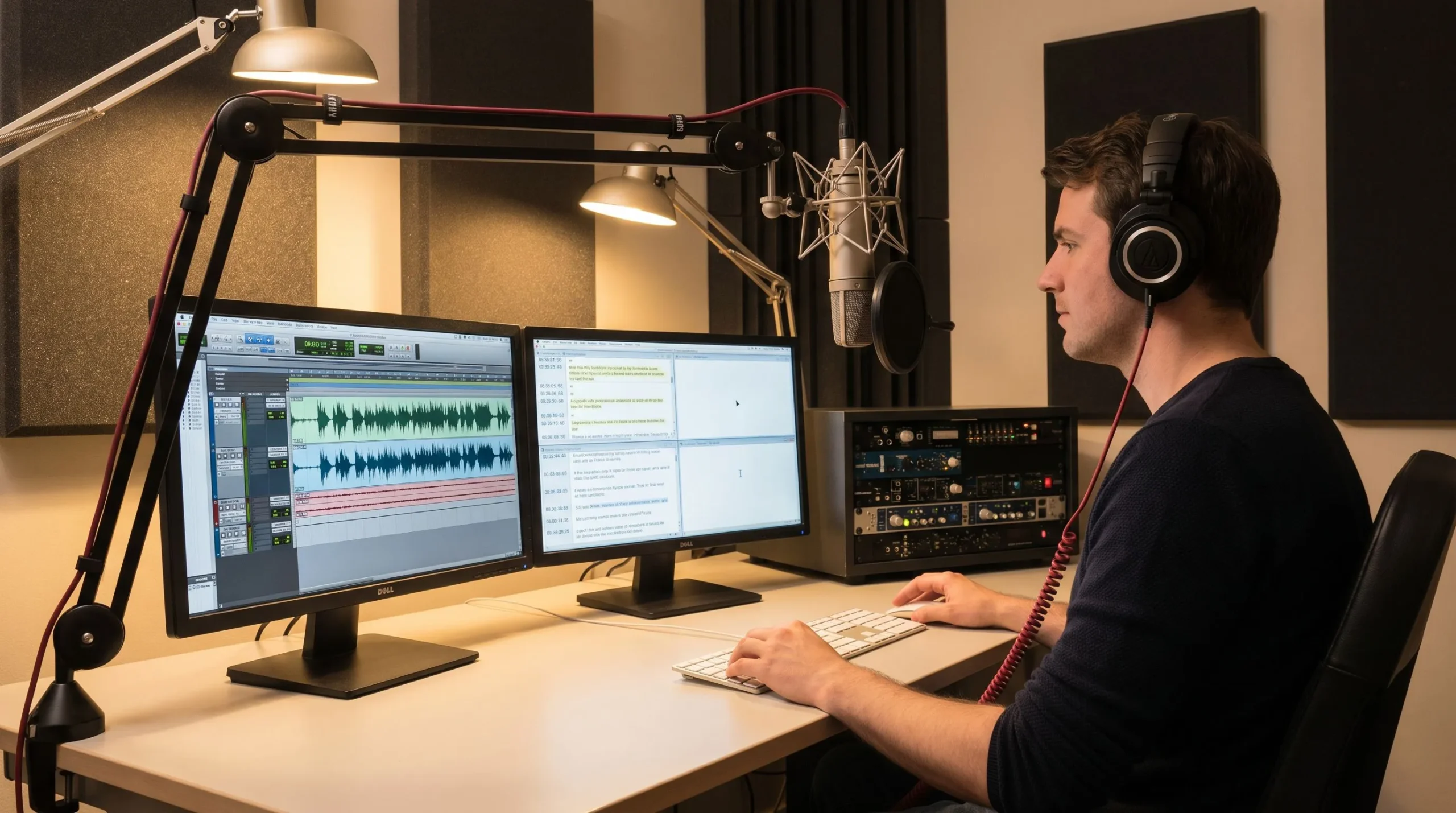
Audio labeling is the process of adding structured annotations to audio recordings so machine learning models can learn from them. Each audio segment gets tagged with metadata: what was said (transcription), who said it (speaker identification), how it was said (emotion, accent, dialect), and what else is happening (ambient noise, music, overlapping speech).
Without accurate labels, speech recognition models produce garbled output. Voice assistants misunderstand commands. Natural language understanding pipelines fail on accented input. The labeling quality determines the model quality.
Audio labeling differs from simple transcription. Transcription converts speech to text. Labeling adds layers of structured metadata on top: speaker diarization tags, phonetic boundary markers, emotion classifications, noise type indicators, accent identifiers, and dialect flags. A single 10-minute audio clip might carry 200+ individual annotations across these dimensions.
Audio Data Types We Label
Different AI applications need different types of labeled audio. We handle all of them under one production pipeline.
Conversational speech
Multi-speaker dialogues with diarization, turn-taking markers, and overlap detection. Used for training conversational AI, call center analytics, and meeting transcription models. We label both scripted and spontaneous speech.
Accented and dialectal speech
This is where most vendors fail. We label speech with accent classification tags and dialect identifiers across 4,500+ dialects. Arabic alone splits into Egyptian, Algerian, Bahraini, Chadian, Iraqi, Jordanian, Lebanese, Libyan, Moroccan, Saudi, Sudanese, Tunisian, and Gulf variants. Our annotators are native speakers of these specific dialects, not generic Arabic speakers guessing at regional pronunciation.
Command and wake-word utterances
Short-form recordings for voice assistant training. We label intent, slot values, background noise conditions, and speaker demographics. Typical projects: 5,000-50,000 utterances per language, 10-50 languages per project.
Music and ambient audio
Genre tagging, instrument identification, mood classification, tempo marking, and lyrics segmentation for music information retrieval models. Environmental sound classification for smart home and automotive systems.
Read and spontaneous speech
Paired read-speech and spontaneous-speech datasets for TTS and ASR training. We capture reading style, prosody markers, and pronunciation variants across regional dialects. Particularly critical for low-resource languages where no public datasets exist.
Audio with code-switching
Bilingual and multilingual speakers who switch languages mid-sentence. We label language boundaries, matrix language, and embedded language segments. Common in Indian, Southeast Asian, and African language contexts where code-switching is the norm, not the exception.
Quality Assurance for Audio Labeling
Audio annotation errors compound downstream. A mislabeled phoneme boundary throws off forced alignment. A wrong dialect tag poisons your accent classifier. Our 3-layer QA framework catches these before delivery.
Layer 1: Pre-production gates
Every annotator passes nativity verification (two forms of ID), domain screening, a 1:1 call, and a project-specific knowledge test. Annotators are classified L1, L2, or L3 based on proficiency, domain expertise, and historical quality scores. Audio labeling projects require L2 or L3 annotators only.
Before production starts, each annotator completes 20-50 calibration items scored against a gold standard. This catches misalignment before it enters your dataset.
Layer 2: In-production controls
Inter-annotator agreement (IAA) is tracked per batch with a threshold of 80-85%. When IAA drops, production pauses for recalibration within the same shift. We do not batch error reports for weekly review; issues are flagged the day they occur.
10-20% of each batch undergoes random review by senior L2/L3 reviewers. For critical audio projects, this scales to 100% review.
Layer 3: Post-delivery review
MQM-based error scoring with severity weighting: critical errors (meaning reversed, wrong speaker ID) weighted at 5x, major errors (partial meaning loss) at 2x, minor errors (slight nuance drift) at 1x. Pass threshold: 90% for AI data annotation, 94% for high-stakes deliverables.
Audio transcription quality target: 90%+ (WER + segmentation accuracy)
Annotators who fall below 85% are recalibrated or removed. Tier re-evaluation happens at project close, not at the end of the quarter.
Use Cases for Labeled Audio Data
Automatic speech recognition (ASR)
Transcribed and phonetically segmented audio trains ASR models to handle diverse accents, speaking rates, and recording conditions. We provide time-aligned transcriptions with word-level and phoneme-level boundaries.
Voice assistants and conversational AI
Intent-labeled utterances, slot-tagged entities, and context-annotated dialogues. We label command variations across dialects so your assistant handles “play music” whether the user speaks Jamaican Patois or Nigerian Pidgin.
Natural language understanding (NLU)
Sentiment, emotion, and intent labels on spoken language. Sarcasm detection, politeness classification, and urgency scoring for customer service and call center applications.
Speaker identification and verification
Speaker diarization labels, voice characteristic tags, and demographic metadata (age range, gender, regional origin) for biometric and security applications.
Audio content moderation
Toxicity, hate speech, and harmful content labels on audio streams. Critical for social audio platforms, podcast hosting, and live streaming services operating across multiple languages and cultural contexts.
TTS and voice cloning
Prosody-annotated read speech with pause markers, emphasis tags, and intonation contours. Phonetic transcription in IPA for pronunciation modeling.
Tools and Delivery Model
We work with the annotation platforms your team already uses, or deploy our own:
- LOFT 2.0 — proprietary platform for large-scale audio transcription and labeling
- Label Studio — open-source, customizable for complex audio annotation schemas
- Trialogger — specialized for dialogue and conversational data
- Descript — transcript-based audio editing and labeling
Delivery follows a rolling batch model aligned to your sprint cadence. Each batch is self-contained: assigned, produced, QA’d, and delivered within the cadence window. The same dedicated team carries project context batch over batch, so you do not re-explain guidelines every week.
Backup bench is pre-staged at 1.5-2x active headcount for Tier 1 and 2 languages. For Tier 3 rare languages, we stage 1.2-1.5x to handle attrition without delivery gaps.
Certifications and Data Security
Audio data often contains PII: speaker voice prints, spoken names, addresses, and medical information. Our security framework is built for sensitive audio handling.
- ISO 9001:2015 — Quality Management System
- ISO 27001:2013 — Information Security Management System
- GDPR compliant data handling
- NDAs executed with every annotator before project access
- Encrypted data in transit and at rest
- Role-based access controls with audit logging
Industry memberships: GALA, ATC, EUATC, Elia, CITLoB.
Frequently asked questions
What is the difference between audio labeling and audio transcription?
Transcription converts speech to text. Audio labeling adds structured metadata on top of the transcription: speaker identity, accent classification, dialect tags, emotion labels, phonetic boundary markers, noise type indicators, and segment-level annotations. A transcription tells you what was said. Audio labeling tells a machine learning model everything it needs to learn from the recording.
How many languages can you label audio in?
We maintain active annotator capacity across 300+ languages and 4,500+ dialects. For audio labeling specifically, we have delivered projects in 60+ rare languages including Fanti, Chadian Arabic, Tok Pisin, and Teso in a single project, and 50+ languages including Chittagonian, Dzongkha, and Herero in another. Tier 1 languages ramp in 3-5 days; rare and indigenous languages require 2-4 weeks for sourcing from diaspora and community networks.
What accuracy rates do you achieve on audio labeling projects?
On our 28,000+ hour audio pipeline across 50+ languages, we achieved 99.2% data accuracy. On a separate 15,000+ hour transcription project across 60+ rare languages, accuracy was 98.7%. These numbers reflect production environments with IAA monitoring at 80-85% thresholds and 3-layer QA. Audio transcription quality targets are 90%+ based on WER and segmentation accuracy metrics.
Is this audit only for companies already working with MoniSa?
No. Most audit clients are evaluating their current vendor setup or preparing for a new project. The audit is vendor-agnostic. The remediation roadmap tells you what to fix — you can implement those fixes with your current provider, with us, or internally.
How do you handle accented and dialectal audio?
We assign native dialect speakers as annotators, not generic language speakers. For Arabic, that means separate annotators for Egyptian, Moroccan, Tunisian, Gulf, Levantine, and other regional variants. Annotators pass nativity verification and dialect-specific calibration tests before entering production. Each dialect is labeled as a distinct category in the output data, so your model trains on genuine phonetic variation rather than approximations.
What is your typical turnaround time for audio labeling projects?
Delivery timelines depend on volume, language count, and annotation complexity. Our 15,000+ hour project delivered in weekly batches. The 28,000+ hour project ran as rolling monthly batches. For smaller projects, we align delivery to your sprint cadence: daily, weekly, or per-milestone. A pilot batch (first 5-10% of the project) undergoes 100% senior review before full production begins.
Can you work with our existing annotation platform?
Yes. We have production experience with Label Studio, LOFT 2.0, Trialogger, and Descript. We also integrate with client-proprietary platforms. If you have a preferred tool and annotation schema, we configure our workflow around it. If you do not have a platform preference, we recommend Label Studio for its flexibility with custom audio annotation schemas.
How do you ensure inter-annotator agreement on audio data?
IAA is tracked per batch against a gold standard, with thresholds set at 80-85% depending on task complexity. When agreement drops below threshold, production pauses and annotators are recalibrated against the gold standard within the same shift. We do not wait for weekly reports to catch drift. For high-stakes projects, we run double-annotation on a subset and measure Cohen’s kappa or Fleiss’ kappa before releasing batches.
Related Services
- AI Data Collection Services — speech, text, image, video, and audio data across 300+ languages
- Low-Resource Language Data — pre-vetted coverage for 50+ rare and indigenous language pairs
- AI Data Readiness Audit — assess your training data pipeline before production begins
- Case Studies — production results across audio, transcription, and multilingual AI data projects
- Contact — scope your audio labeling project with our team
Send us your hardest audio labeling challenge: the language pair no one else covers, the dialect your current vendor keeps mislabeling, the accent variant your ASR model cannot handle. We will scope it, assign a pilot batch, and show you what production-quality audio labels look like.