Balochi Translation Services
VETTED LINGUIST NETWORK
Sourcing confirmed within 1-2 weeks for most services.
ISO 9001 | ISO 27001 | ISO 17100
Written by the MoniSa Enterprise team. Last reviewed: March 2026.
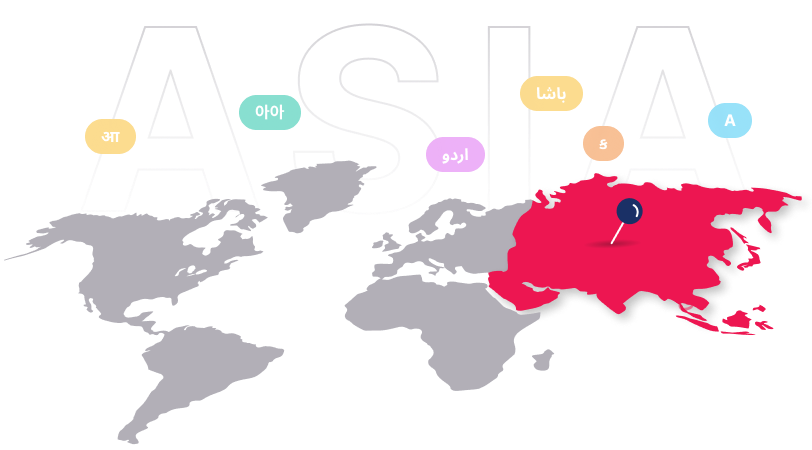
Balochi spans three countries and three dialect branches. Eastern (Pakistan), Western (Iran), and Southern (Makran coast), with no unified orthography and virtually zero MT coverage for any variant. As a Northwestern Iranian language, Balochi is linguistically closer to Kurdish and Dari than to the Urdu and Punjabi that surround it in Pakistan, creating a sourcing challenge that most vendors do not recognize. MoniSa maintains a vetted Balochi linguist network drawing from Quetta, the Makran coast, and Gulf diaspora communities, with delivery infrastructure proven on a 28,000-hour audio project that included related Western Iranian languages.
When teams need Balochi translation
- An AI company collecting speech data across Iranian language varieties needs Balochi audio annotated with dialect-specific labels (Eastern, Western, Southern) because models trained on Farsi or Urdu data cannot parse Balochi phonology or morphology.
- A humanitarian or development organization operating in Balochistan discovers that Urdu-language materials do not reach Balochi-speaking communities in rural Pakistan, where Urdu literacy is limited and Balochi is the language of daily life.
- A media company or broadcaster covering the Balochistan region needs subtitling or transcription in Balochi and cannot find vendors who handle the Nastaliq script variant or distinguish between the three major dialect groups.
- A government or cross-border program spanning Pakistan, Iran, and Afghanistan requires Balochi content that accounts for orthographic differences — Nastaliq in Pakistan, Persian-Arabic in Iran, across the same language.
Balochi services we deliver
Linguists sourced from Quetta and the Makran coast in Pakistan, plus Balochi diaspora communities in the UAE, Oman, and Turkmenistan. University of Balochistan (Quetta) and Balochi literary societies provide the academic pipeline for specialized and domain-specific work.
Script note: Balochi in Pakistan uses Nastaliq script (RTL). Balochi in Iran uses a Persian-Arabic orthographic variant. Balochi in Turkmenistan historically used Cyrillic until the 1990s. Script selection is confirmed at scoping based on the target country and audience. RTL rendering validation is included for all Nastaliq and Persian-Arabic deliverables.
Dialect note: Eastern Balochi (Quetta region), Western Balochi (Iran’s Sistan-Baluchestan), and Southern Balochi (Makran coast) are distinct enough to require dialect-matched linguists. Cross-dialect intelligibility exists but vocabulary and phonological differences affect translation accuracy.
Our Balochi
translation process
step 1
Scope and match
Dialect branch (Eastern, Western, or Southern), target country, script convention, and domain confirmed before linguist assignment. For Balochi, scoping includes identifying whether the content targets Pakistan, Iran, or a cross-border audience, as this determines orthography, vocabulary preferences, and linguist sourcing geography.
step 2
Execute and review
Balochi translation follows TEP with an Urdu-interference check for Pakistan-targeted content and a Farsi-interference check for Iran-targeted content. Editors verify that the Northwestern Iranian grammar and vocabulary of Balochi are preserved rather than replaced by the dominant national language of the target country.
step 3
Deliver and report
Batch delivery with QA reports covering Urdu/Farsi-interference rate, script rendering validation, dialect consistency, and terminology adherence. For cross-border projects, orthographic normalization across country variants is tracked as a quality dimension.
Balochi at a glance
Balochi is a Northwestern Iranian language spoken by approximately 8 million people across a territory that spans three countries: Pakistan’s Balochistan province, Iran’s Sistan-Baluchestan province, and southern Afghanistan. Despite being surrounded by Indo-Aryan languages (Urdu, Punjabi, Sindhi) in its largest speaker base in Pakistan, Balochi’s closest linguistic relatives are Kurdish and Dari — a genealogical fact that shapes its grammar, vocabulary, and morphological patterns in ways Urdu-trained linguists cannot reproduce. The language lacks a unified orthography: Pakistan uses Nastaliq, Iran uses a Persian-Arabic variant, and Turkmenistan used Cyrillic until recently. This fragmentation, combined with minimal digital presence, means no MT engine supports any Balochi dialect. Diaspora communities in the Gulf states (UAE, Oman) and East Africa add further geographic spread to the sourcing challenge.
Quality control
All Balochi work follows MoniSa’s 3-layer review model: translator (native Balochi speaker, dialect-matched to Eastern/Western/Southern, verified for Northwestern Iranian vocabulary retention), editor (bilingual accuracy and terminology adherence with Urdu/Farsi-interference screening), proofreader or community validator (cultural and dialectal review). The quality bar holds whether the language is high-resource or rare.
Proven delivery
257,000 words delivered across 8 rare languages spanning 4 scripts in 10 days at 99.8% accuracy. Balochi presents the same challenges as the rare languages in that project: limited digital resources, diaspora-dependent sourcing across Pakistan, Iran, and the Gulf states, and dual-script output requiring Arabic and Latin validation at every review layer. The same linguist vetting, rolling batch delivery, and script-specific QA framework from that engagement are the standard operating procedures for all Balochi work.
Buyer risk controls
Linguist replacement SLA
Vetted network means replacement Balochi linguists can be sourced within 1-2 weeks. The Quetta-based academic community and Gulf diaspora provide backup depth across Eastern and Southern dialect branches.
Quality parity guarantee
No separate quality standard exists for rare languages. Every deliverable meets the same accuracy, terminology, and fluency benchmarks.
Transparent sourcing status
Linguist availability is a scoping-stage disclosure, not a production-stage discovery. Sourcing timelines are built into project commitments upfront.
Governance and security
Certified: ISO 9001:2015, ISO 27001:2013, ISO 17100:2015.
Memberships: Member of GALA, ATC, EUATC, Elia, and CITLoB — international language industry associations.
Security:GDPR-compliant. NDAs standard. Encrypted transit and storage.
Frequently asked questions
What is your Balochi linguist capacity?
Balochi has three major dialect groups. Eastern (Quetta region, Pakistan), Western (Sistan-Baluchestan, Iran), and Southern (Makran coast). MoniSa’s vetted network covers Eastern and Southern Balochi through Quetta-based and Gulf diaspora linguists. Western Balochi sourcing from Iran is available on-request with additional lead time.
How does Balochi differ from Urdu, and why does that matter for translation?
Balochi is a Northwestern Iranian language, genetically closer to Kurdish and Dari than to Urdu. Its verb morphology, case system, and core vocabulary are fundamentally different from Urdu’s Indo-Aryan structure. Assigning Urdu linguists to Balochi work produces output in Urdu with Balochi words inserted — not an authentic Balochi translation. Dialect-matched native speakers are the minimum staffing requirement.
How long does sourcing take for Balochi?
For TEP, annotation, and audio, 1-2 weeks via the vetted network. For subtitling, 2-3 weeks. For dubbing, 3-4 weeks. Sourcing begins at scoping, and the timeline is confirmed before project commitment.
What quality metrics do you report?
Per-linguist accuracy scores, MQM error categorization, Urdu/Farsi-interference rate (depending on target country), script rendering validation, dialect consistency, and terminology adherence. For cross-border projects, orthographic normalization metrics are included.
Related
Ready to talk?
ISO 9001 | ISO 27001 | ISO 17100 certified. 300+ languages. Vetted Balochi linguist network covering Eastern, Western, and Southern dialects. Backed by 35,500+ vetted linguists worldwide.