What Is NLP Data Annotation?
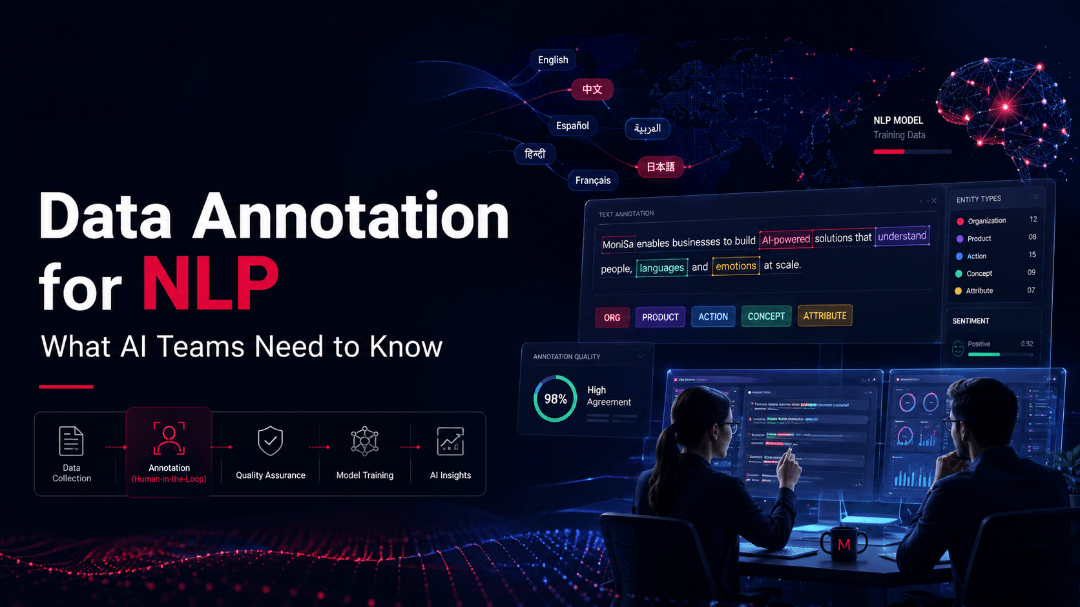
NLP data annotation is the process of labeling text data so that machine learning models can learn from it. Every time a chatbot understands your question, a search engine grasps your intent, or a content moderation system flags a toxic comment, there is annotated training data behind that capability.
Annotation transforms raw, unstructured text into structured, labeled datasets. A sentence like “Book a flight to Paris next Friday” becomes training data when a human annotator marks “Paris” as a location entity, “next Friday” as a time expression, and the overall intent as “travel booking.”
Without accurate annotations, models learn the wrong patterns. They hallucinate entities, misclassify intent, and fail silently on edge cases. The annotation quality directly determines the model quality.
Types of NLP Data Annotation
Named Entity Recognition (NER)
NER annotation involves identifying and classifying named entities in text: people, organizations, locations, dates, monetary values, products, and domain-specific entities. For a medical NLP model, annotators label drug names, dosages, symptoms, and anatomical terms. For a financial model, they label company names, stock tickers, currency amounts, and regulatory references.
The challenge: entity boundaries are ambiguous. Is “New York Times” one entity or two? Is “Dr. Smith” a person entity or should “Dr.” be a separate title tag? Annotation guidelines must address these decisions explicitly, and annotators need domain training to handle them consistently.
Part-of-Speech (POS) Tagging
POS tagging assigns grammatical labels to each word: noun, verb, adjective, adverb, preposition, and so on. This is foundational for syntactic parsing, machine translation, and text generation.
In English, POS tagging is relatively straightforward. In morphologically rich languages like Turkish, Finnish, or Hungarian, a single word can carry information that English spreads across an entire phrase. Arabic presents additional complexity with its non-concatenative morphology and the ambiguity created by unvoweled text.
Sentiment Analysis Annotation
Sentiment annotation classifies text as positive, negative, neutral, or mixed. For product reviews, social media monitoring, and brand perception analysis, annotators rate not just overall sentiment but also aspect-level sentiment: a restaurant review might be positive about food quality but negative about wait time.
Cultural context matters heavily here. Sarcasm, understatement, and indirect criticism vary dramatically across languages and cultures. What reads as a compliment in one market may be a veiled complaint in another.
Intent Classification
Intent annotation labels what a user is trying to accomplish: “book a flight,” “check order status,” “file a complaint,” “ask for information.” This is critical for chatbots, voice assistants, and customer service automation.
Real user inputs are messy. They misspell words, use slang, mix languages (code-switching), and express multiple intents in a single message. Annotators need to handle these edge cases according to consistent guidelines, not just label the obvious examples.
Coreference Resolution
Coreference annotation identifies when different expressions in a text refer to the same entity. In “MoniSa Enterprise delivers AI data services. The company was founded in 2015,” annotators link “The company” back to “MoniSa Enterprise.”
This task is computationally and linguistically complex. Pronouns, definite descriptions, and implicit references all need to be resolved. In languages with grammatical gender (Spanish, Arabic, Hindi), coreference patterns differ significantly from English.
Other Annotation Types
| Annotation Type | Purpose | Common Applications |
|---|---|---|
| Text Classification | Categorize documents by topic, genre, or type | News categorization, spam detection, document routing |
| Relation Extraction | Identify relationships between entities | Knowledge graph construction, biomedical NLP |
| Semantic Role Labeling | Identify “who did what to whom” | Question answering, information extraction |
| Discourse Annotation | Label rhetorical structure and coherence | Summarization, argument mining |
| Toxicity and Safety Labeling | Classify harmful, biased, or unsafe content | Content moderation, AI safety, RLHF |
Why Multilingual NLP Annotation Is the Hard Problem
Most NLP research and tooling is built for English. When AI teams expand to other languages, they discover that annotation complexity increases in ways they did not anticipate:
Structural Differences
Languages differ in word order (English is SVO; Japanese is SOV; Arabic is VSO), morphology (Turkish agglutinates meanings into single words that require entire English phrases), and writing systems (Chinese has no word boundaries; Thai has no spaces between words). Annotation guidelines written for English break down immediately.
Script and Encoding Challenges
Annotating text in Devanagari, Arabic, Thai, Khmer, or Ge’ez scripts requires tools that handle right-to-left text, complex character shaping, and script-specific tokenization. Many annotation platforms were designed for Latin-script languages and handle these poorly.
Low-Resource Language Gaps
For languages like Marshallese, Hmong, Sylheti, or Chittagonian, pre-trained models, tokenizers, and NLP toolkits simply do not exist. Everything must be built from scratch, starting with native-speaker annotators who can create gold-standard training data.
Cultural and Pragmatic Variation
Sentiment polarity, politeness markers, humor, and formality registers vary across cultures. An intent classifier trained on American English customer service conversations will misclassify queries from Japanese or Arabic speakers who express complaints indirectly.
Annotator Availability
Finding qualified annotators for high-resource languages like Spanish or Mandarin is straightforward. Finding annotators for Tigrinya, Pashto, or Quechua who also understand NLP annotation conventions requires specialized sourcing through diaspora networks, academic partnerships, and community outreach.
How MoniSa Delivers NLP Annotation Projects
MoniSa Enterprise has delivered thousands of AI data projects across 140+ languages, including annotation work for NLP model training. Here is what that looks like in practice.
Native-Speaker Annotators at Scale
We source annotators from a network of tens of thousands of vetted linguists, covering 300+ languages and 4,500+ dialects. For rare languages, we activate diaspora networks, academic partnerships, and community outreach, with typical sourcing timelines of 2-4 weeks for new language activation.
Calibrated Quality from Day One
Every annotator passes a 6-step vetting process before touching production data. Project-specific calibration uses 20-50 gold-standard items so every annotator grades against the same benchmark. During production, inter-annotator agreement (IAA) is tracked per batch with an 80-85% threshold, and senior reviewers check 10-20% of all work.
Rolling Batch Delivery
Work moves in sprint-aligned batches. Each batch is self-contained: assigned, annotated, quality-checked, and delivered within the agreed cadence. The same annotator team carries project context batch over batch, which is why rework rates stay below 2% on comparable projects while the industry average runs 10-12%.
Proven Volumes
- 110,000+ text data units collected and annotated across multiple NLP projects
- 125,000+ units labeled across data labeling engagements
- 120,000+ LLM prompts created and validated for AI training and evaluation
- 28,000+ hours of transcription, annotation, labeling, and segmentation across 50+ languages on a single AI data pipeline project, achieving 99.2% data accuracy
ISO-Certified Security
All annotation work operates under ISO 9001:2015 (Quality Management) and ISO 27001:2013 (Information Security) certifications. Data is encrypted in transit and at rest, with strict role-based access controls and NDAs signed before every engagement.
What to Look for in an NLP Annotation Partner
If you are evaluating vendors for NLP annotation, here are the questions that separate serious providers from crowd-labeling platforms:
- How do you source and vet annotators for non-English languages? Crowd platforms rely on self-reported language skills. Professional providers verify nativity with documentation and test domain knowledge before production.
- What is your inter-annotator agreement (IAA) tracking process? If a vendor cannot tell you their IAA methodology, they are not measuring consistency.
- How do you handle annotator disagreement? Adjudication protocols, majority voting, and expert arbitration each have tradeoffs. The right approach depends on your annotation type and quality requirements.
- Can you show rework rates from a comparable project? Rework rate is the most honest quality metric. Industry averages run 10-12%. Below 2% indicates strong calibration and reviewer consistency.
- What is your experience with my specific language pairs? General “we support 200+ languages” claims mean nothing. Ask for specific project references in your target languages.